
“Painting hollyhocks looks simple to paint at first, but the characteristic leaves and stalks can be a challenge,” says Buffalo Kaplinski. “I find watercolor to be the best medium for capturing their crisp edges and shapes. Found in a number of Western landscapes, and grown in a variety of colors, they seem to thrive in dry places in my garden.
“Most of us who make representational art are interested in drawing and take time to hone that skill; in watercolor especially, there’s no faking it. The trick to a crisp, fresh, and believable watercolor is making a careful drawing without detailing every shape; watercolor is a fluid media, after all.
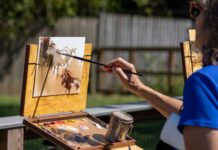
“I prefer an HB pencil for drawing, but before putting in even the lightest values, I think carefully about the color I want for the painting. Even when I’m painting en plein air, I use the best brushes I can find to get the best results in my work — most often a No. 7 (or No. 8) long-handle professional red sable by Winsor & Newton, a Princeton No. 6 liner, a No. 4 by Black Velvet, and a No. 6 Silver Brush script. I also like Cheap Joe’s Dream Catcher brushes. I never use any masking fluid. I prefer painting around negative and positive shapes the way I was taught by Irving Shapiro.”
Looking for MORE ways to improve your skills?
Join us for the next Plein Air Live online art conference! Plein Air Live gives you invaluable insights and live demonstrations from some of the world’s best plein air artists. Over the course of 3-4 exciting days, they’ll reveal techniques to improve your use of color, light and shadow, giving you the confidence and skills to paint outdoors and create more amazing artwork than you ever have before. Learn more at PleinAirLive.com.
Browse more free articles here at OutdoorPainter.com
Blog post prepared for the web by Cherie Dawn Haas, Editor of Plein Air Today