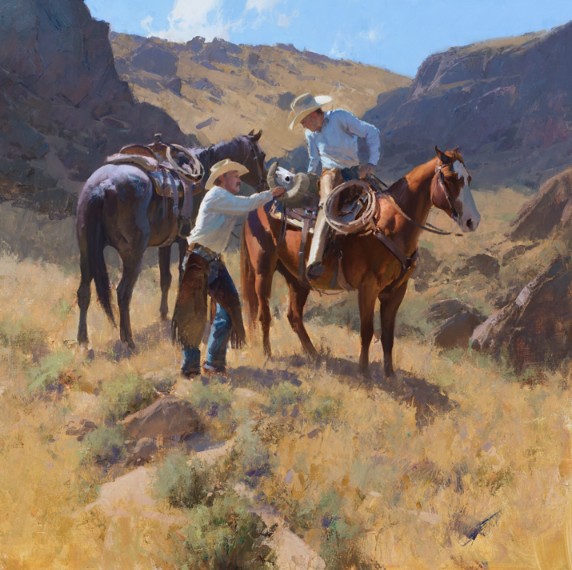
Although known primarily for his outstanding horses and figures in western landscapes, the renowned painter Bill Anton’s handling of scenes behind and around the figures is something thrilling to behold.
It’s my pleasure to interview Bill, the fifth artist in our “6 Questions for 6 Artists” series.
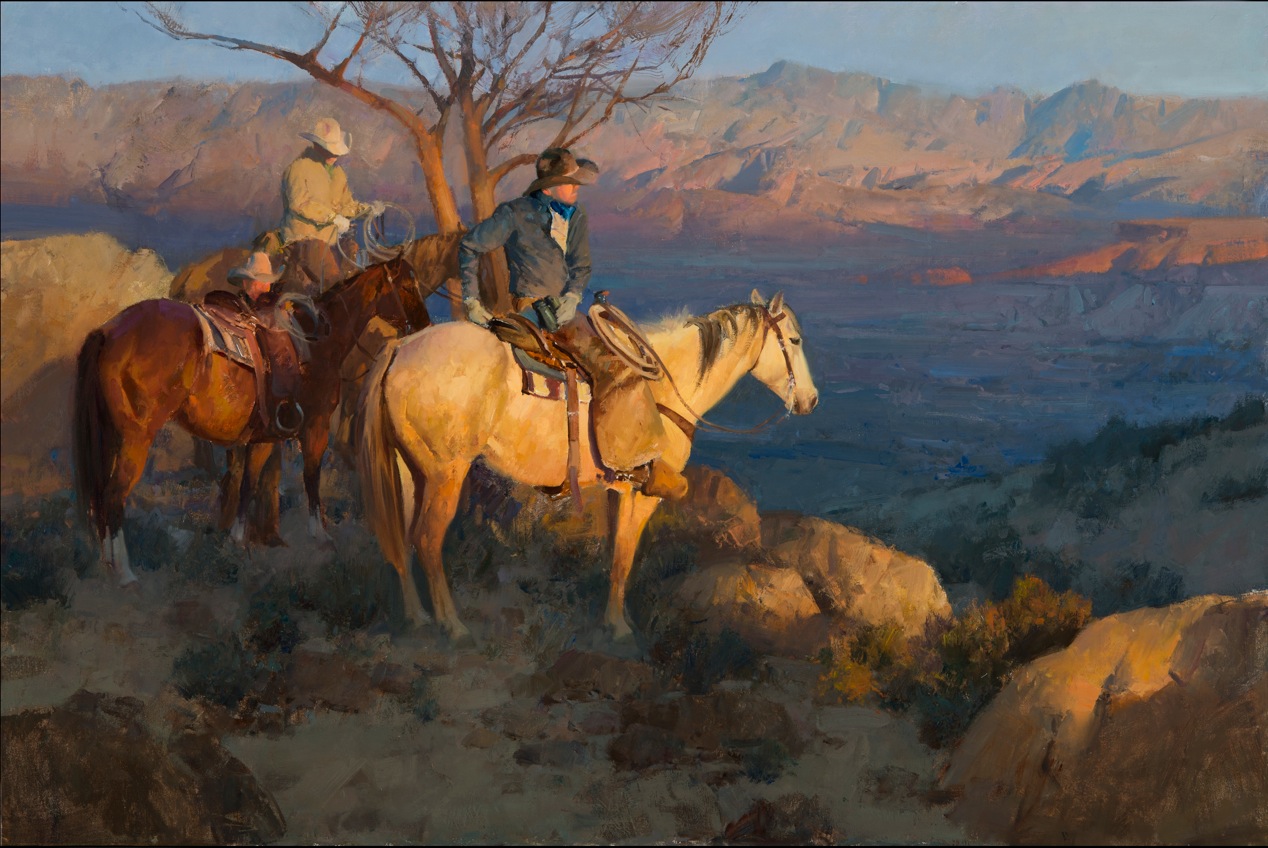
John Hughes: Bill, thanks for taking the time to let me pick your brain. You’re primarily known as a western artist, but some of us have long admired your handling of horses and figures, and the landscapes behind these subjects are superb; juicy brushwork comes to mind.
Would you briefly tell our readers the thought process behind painting certain areas of a canvas loosely, in an expressionistic manner, as opposed to more rendered passages of the canvas, and how you find the right balance between the two?
Bill Anton: I was always told that if the figure enters a painting, then the painting becomes about the figure. So the figures are generally handled more literally, and the background becomes the foil for the figure. As a result, the background landscape is more loosely handled than the figure; the landscape has a supporting role. But that’s sometimes easier said than done when Mother Nature is putting on a show. Having said that, I personally find the landscape easier than the figure, probably because you are allowed more latitude in interpretation when depicting the land. Anatomy is somewhat more restrictive; let’s be honest.
John: Who were some of your major influences from past generations, and were any of them pure landscape painters?
Bill: I always loved the California Impressionists, particularly Edgar Payne, Hanson Puthuff, and William Wendt, who were primarily landscape painters, though Payne occasionally added figures, usually for scale. Sorolla, of course, as well as Anders Zorn. Compton and Heinrich von Zügel are also inspiring past masters.
Jim Reynolds and Ned Jacob were contemporary, and I was fortunate enough to study with both. Each featured the figure; Ned much more so than Jim.
As for the western subject, no one surpassed Frank Tenney Johnson in my view, and he was equally adept at figure and landscape; combining them was his forte.
John: How did you get started in painting as a youth?
Bill: I wasn’t all that young, probably about 22 or 23 years old before I picked up a brush. But I was told very early on that if I wanted to learn to paint, I should go outside a lot: best advice I ever got!
Enjoying this story? Sign up for the Plein Air Today newsletter to stay in the know!
John: How would you describe your excitement level for painting these days, as opposed to when you were first starting?
Bill: When I was a kid, I was hungry for success as a painter…I didn’t want to have to work at something I hated (like a real job), and I needed notoriety to be able to stay in the game. That’s heady stuff sometimes for a kid… ‘a little notoriety’. Fortunately, I was mentored by purists. I fell in love with learning the craft, and I’m still learning. The major difference now is that I don’t care about the notoriety, and I just want to paint for the sheer joy of doing it!
John: Do you have any color harmony tips for our readers?
Bill: Not really, I’ve never been good at explaining why I choose certain harmonies. I paint on a painting until it looks right to me. I’m not a color theory guy.
John: What principles make for a solid design in a landscape painting, or a landscape painting with figures, because the principles are all the same?
Bill: I try to hold the viewer’s eye inside the painting by use of line and value; I don’t want your eye [to exit the canvas], so I usually attempt some form of circular, linear movement that continually throws you back into the painting or the center of interest. Other than that, I think about balance. I think about darkest dark, lightest light, or sometimes the strongest color right at or near the subject. I also think about variety, how to break up the space (grouping), so that nothing is too symmetrical…things like that.
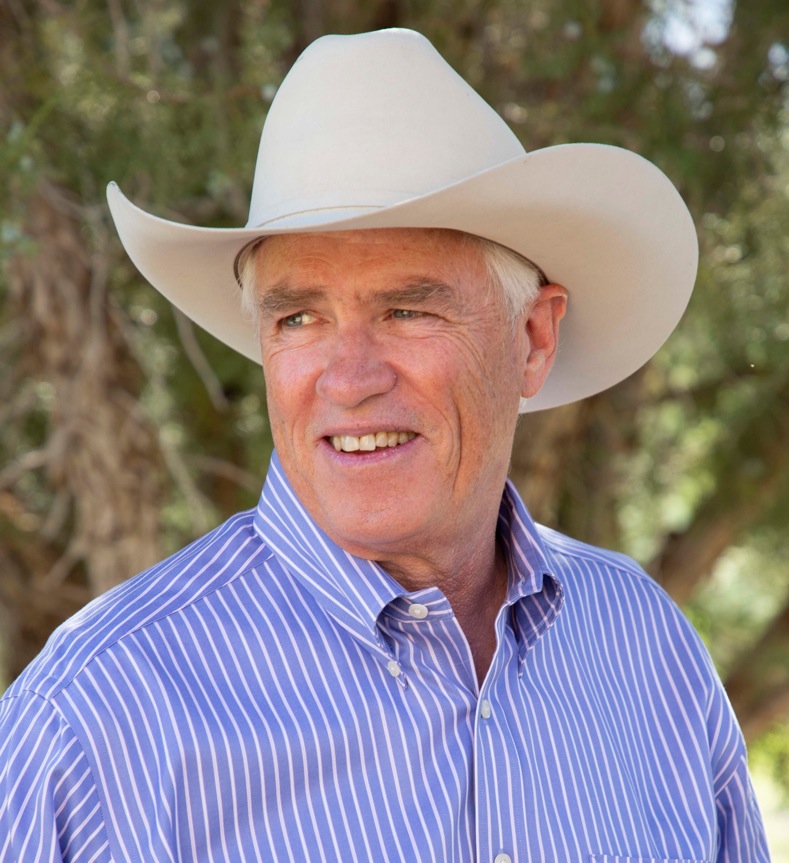
I’d like to give big thanks to Bill for his straightforward answers and his sage observations on the painting process, as he perceives and practices what he does so well. There is much to be appreciated and learned from this great artist.
Who will be next in our “6 Questions for 6 Artists” series? Stay tuned!
Until next time,
~John