

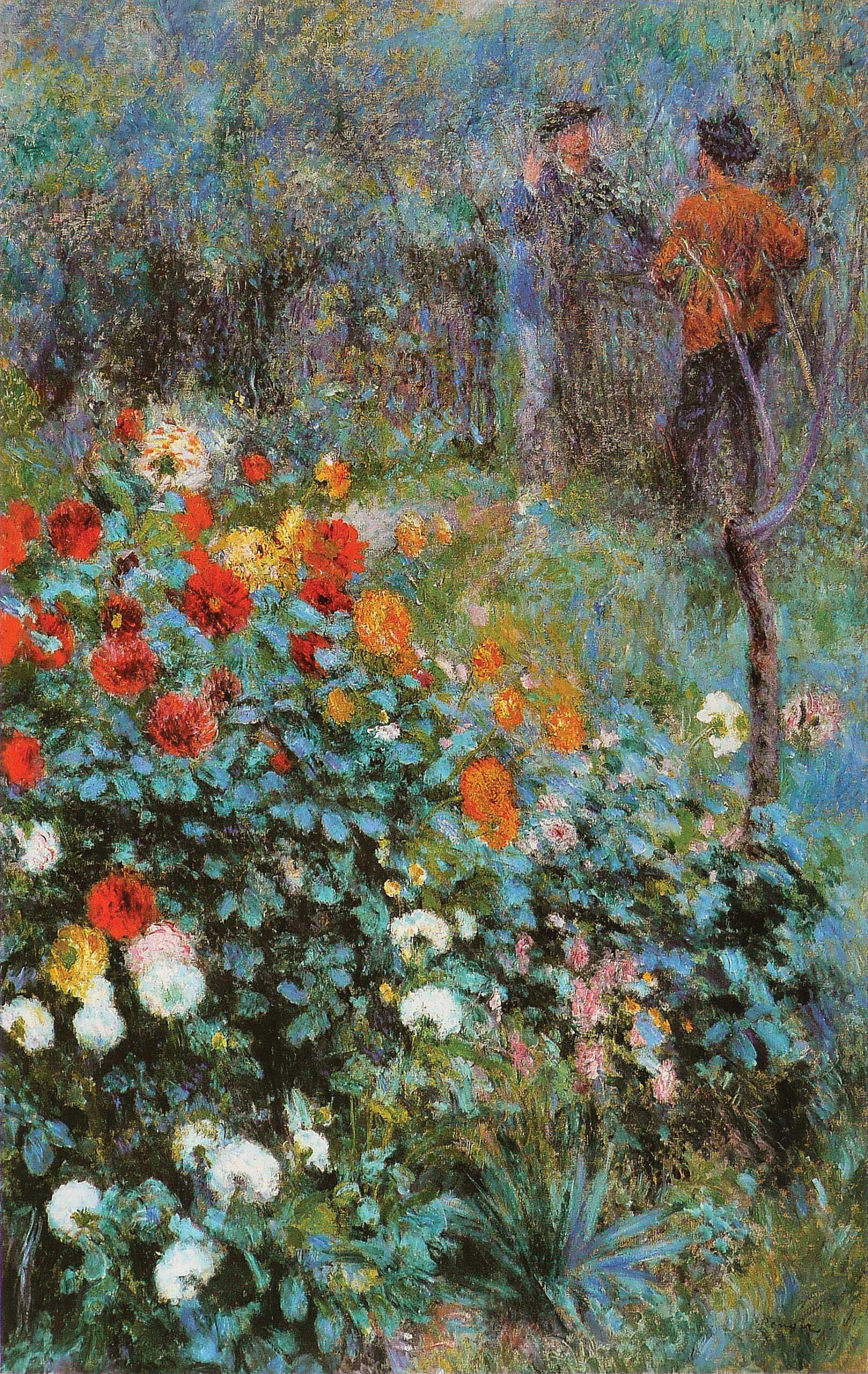
In stark contrast to the deliberately planned and maintained plots at Giverny, the garden that inspired Claude Monet’s friend and fellow Impressionist Pierre-Auguste Renoir (French, 1841–1919) proved a much wilder affair. (Click here to see the first article in this installment, “Secret Spaces That Became Art: Giverny”)
Once part of the grounds of an 18th-century chateau, the garden in the rue Cortot, Montmartre, had fallen into neglect by the time the artist discovered it around 1875. Its wild beauty and proximity to the Moulin de la Galette (soon to be the subject of one of his most famous paintings) persuaded Renoir to rent a tumbledown cottage on the street for himself and his family. From that point on, the garden served the artist as both an outdoor studio and a subject for painting.
In “Le Jardin de la rue Cortot à Montmartre,” the untamed nature of the garden lends itself to the broad and varied brushwork of the Impressionist style. Blazing dahlias in the foreground dominate our attention. In the background, as if an afterthought, two male figures — possibly the artist’s friends Monet and Alfred Sisley — converse over a wicker gate. Renoir’s free, flickering brushstrokes seem to weave the two figures into the patterns created by the cool light and the contrasting shade that envelop the garden.
Stay tuned for upcoming installments on this series of “secret spaces” and now-famous painting locations.
Published bi-monthly, PleinAir magazine is focused on landscape paintings by historical and contemporary artists, art collections, events, and the process of creating plein air paintings. Beautifully designed with rich reproductions on high-quality paper, PleinAir features the top artists and artworks from around the world. Start your subscription here.
Story prepared for the web by Cherie Dawn Haas, Editor of Plein Air Today

