Artist Paul Kratter shares three examples of how to paint trees with character by taking artistic license, playing with color, and building light and shadow.
How I Paint Trees with Character
By Paul Kratter, featured in the PaintTube.tv workshop, “Mastering Trees”
Trees serve as my portrait subjects, so I’m always on the lookout for examples with character.
TAKING ARTISTIC LICENSE
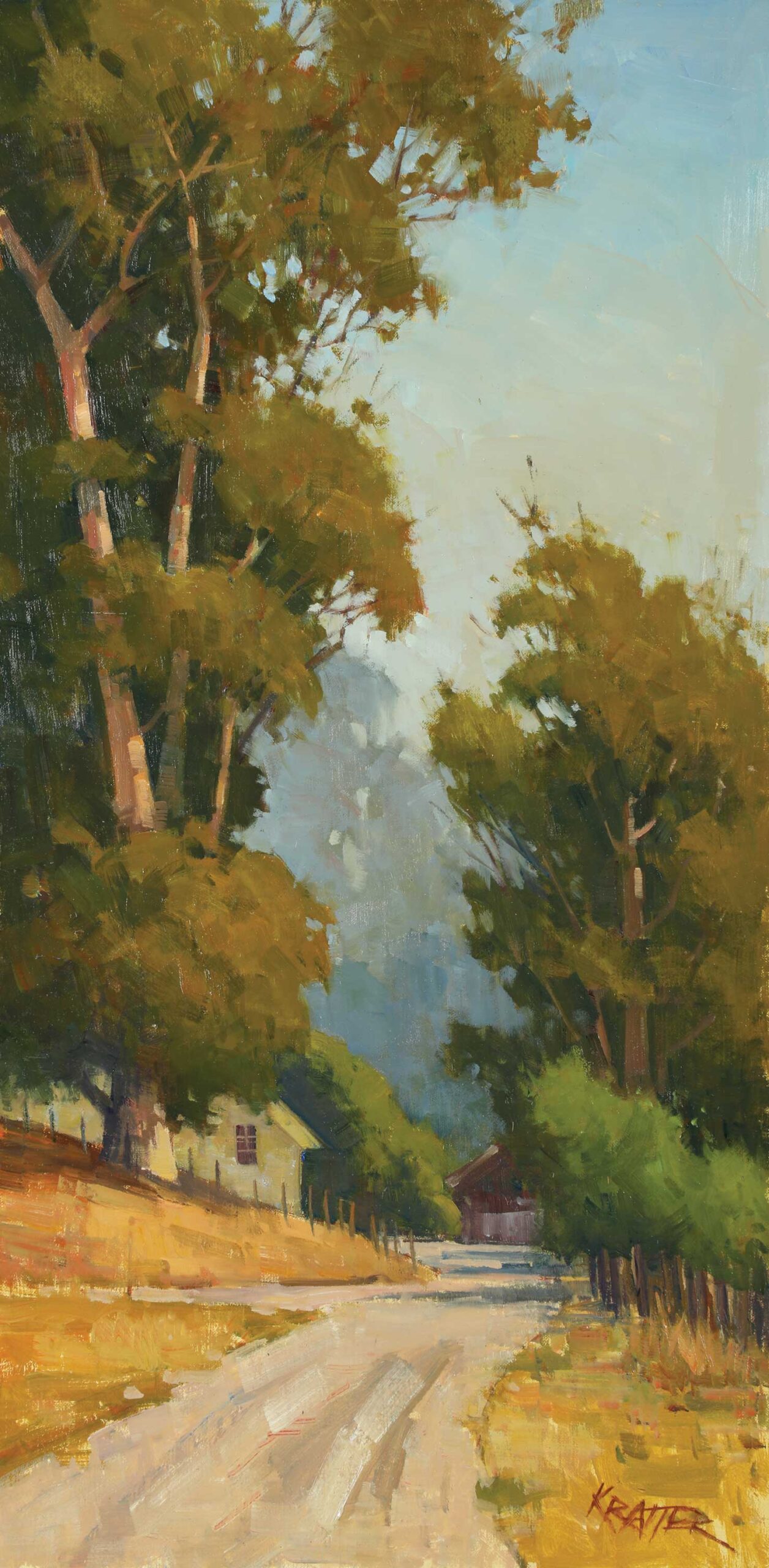
Eucalyptus trees generally have straight trunks, and in the scene that inspired “Down the Lane” (shown at top), the one on the left was fairly straight, but it was a grayish color, completely in shadow. In the painting, I gave the tree an orangish tone to make it more interesting and to make the scene feel like it was a little later in the day, something I tend to do. Also, the tree on the right wasn’t actually a eucalyptus but another variety that wasn’t as interesting. It was the same size, though, so I simply changed it to a eucalyptus as well.
I painted the trunks and major branches in shadow first, and those in the light later, softening the edges as they moved into shadow. I gave the smaller branches more character with sharper angles, and tapered them as they went up into the canopy. I started the groups of foliage as spheres of various sizes and shapes, and lit the top and right edges so it was apparent where the light was coming from. I also chose to cut off the top of the left tree because compositionally it made the scene more dramatic, plus we see the entire tree on the right.
Finally, I added the sky holes. I kept them along the edges of the trees, and varied the sizes and shapes. Note: Placing sky holes in the middle of trees tends to thin them out. I also softened the edges of the foliage with the sky color and by pushing some of the foliage color into the sky. To add a bit more character into the trees, I extended some thin branches into the sky.
This particular day was very clear, and the background trees were almost the same value and intensity as the two main trees. I chose to simplify the shape by making it a silhouette, which gave the scene some needed atmosphere.
PLAYING WITH COLOR
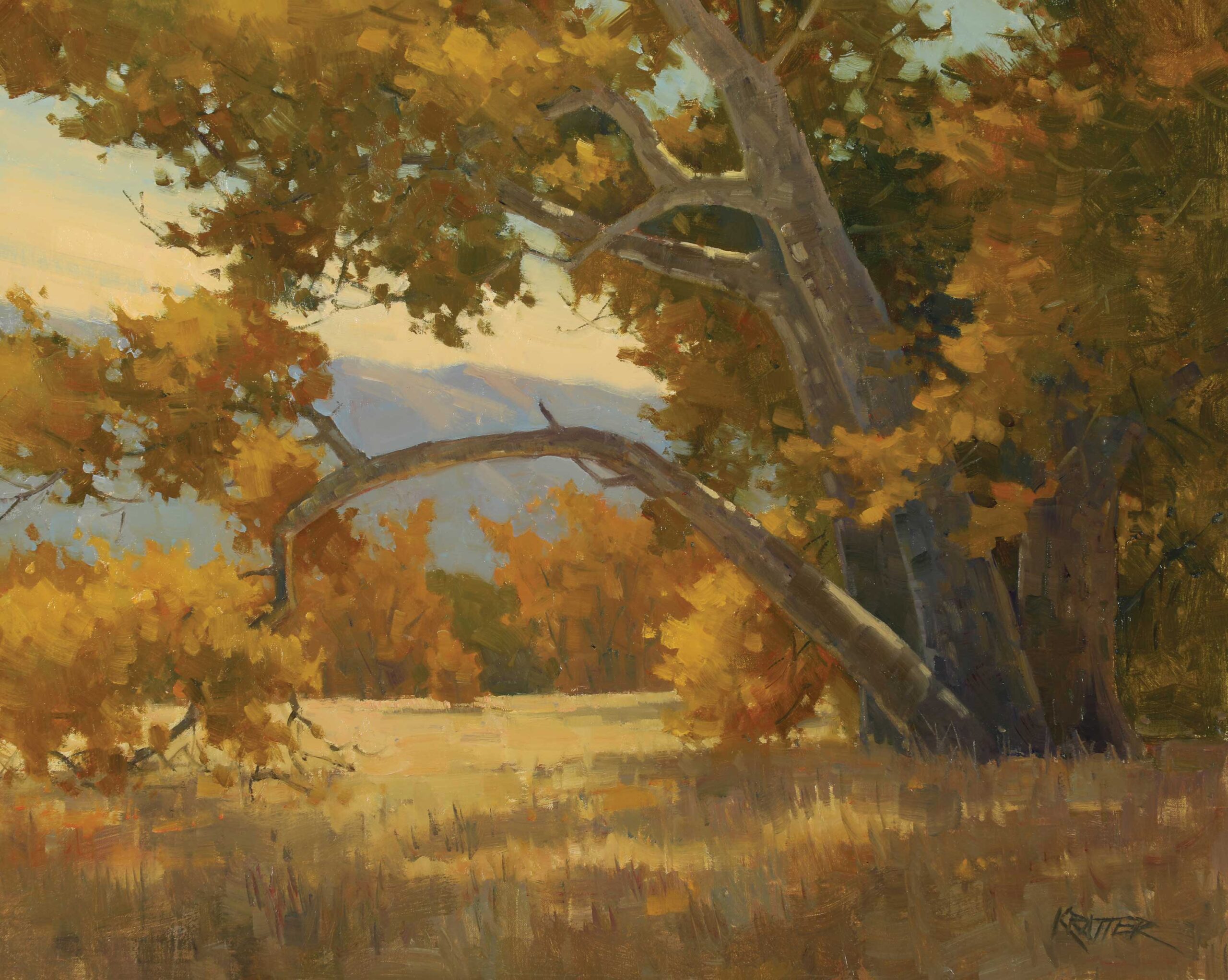
I’ve painted one particular sycamore tree with an unusual branch a few times; the painting “Overhang” shows it in the fall. The trunks of this type of tree can grow straight but often have sharp angles. The colors can vary from a whitish value to a mid-tone gray, with some darker patches on the bark. I love the slight variations in color, but it’s important to keep the values similar. I block in the entire foliage with one mid-tone value and then start painting in the light shapes and adding the denser shadows. The leaves are quite big, which makes the foliage shape spiky. The fun part of painting this tree is the color of the leaves. I like to vary the color just slightly to make the painting more interesting up close.
For the distant trees in this piece, I used less value change than on the foreground tree and muted the color as well. In the final stages, I indicated light on the trunks of the main tree. I chose to just hit the top edge on a few of the branches. I also added a few loose branches on the far left where they touched the ground and reached into the sky. I was careful not to paint them too dark as the light filters around them.
BUILDING LIGHT AND SHADOW
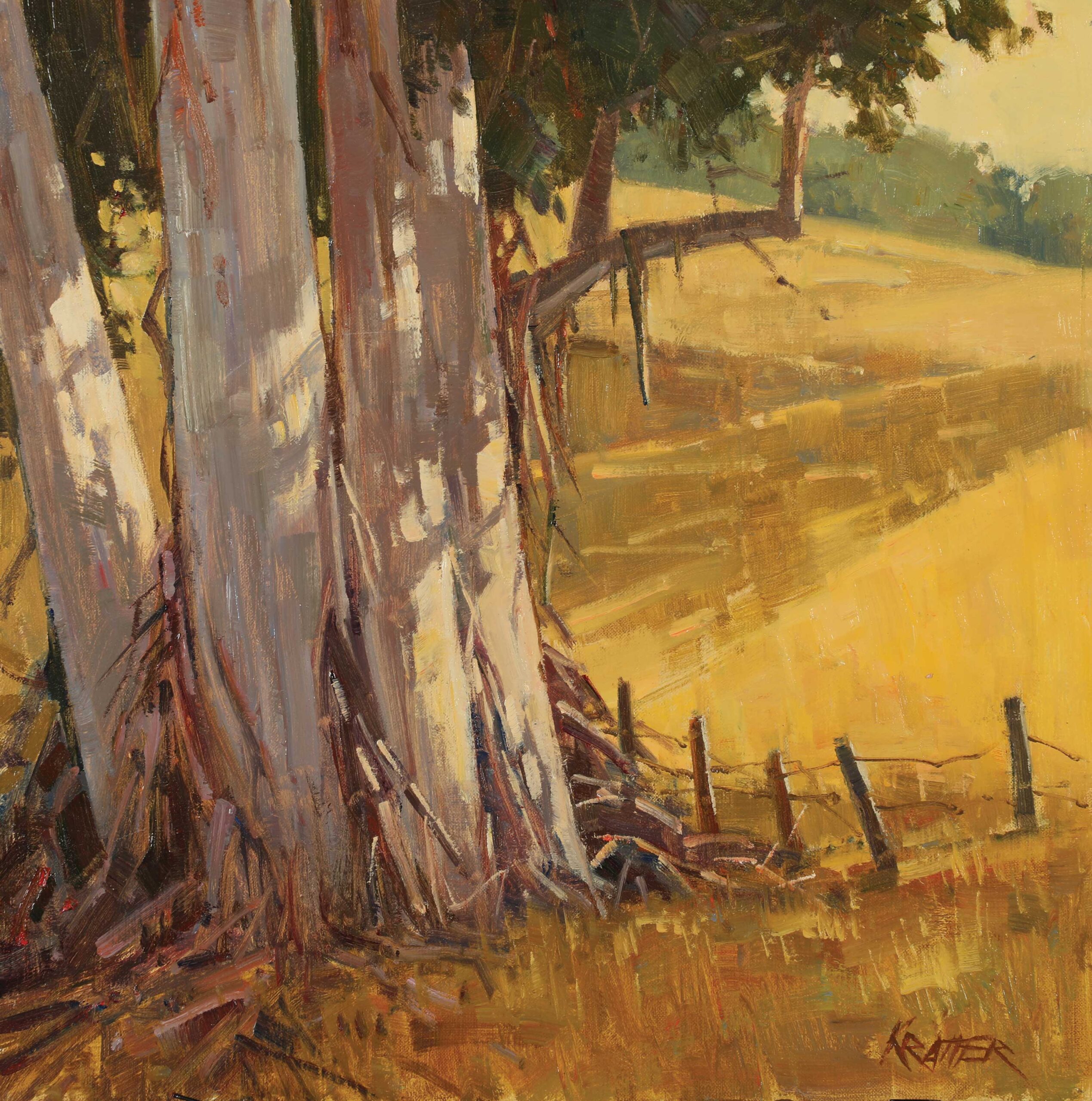
The trunks of the eucalyptus in “Baked!” had a very whitish color to them. I was drawn to the bright light shining on them juxtaposed with the dark bark debris. I painted the shadow on the trunks first, keeping the value pretty light, semi-transparent, and loose. There’s more color variation, although slight, in the shadow areas.
You’ll also notice the brushwork follows the vertical nature of the trunks. The light is opaque and on the warm side. The bark is kept loose, and it too has more variations in the shadows. Although there was a little light hitting the foliage, I chose to keep it mostly in the shade. I kept my original outline in the trunks visible to make the painting a little more graphic. The title refers to the 100-degree temperature on the day it was painted.
In his art workshop “Mastering Trees,” paint along with Paul Kratter and discover how to take landscapes and trees from complicated to simple and logical. [Learn how to paint trees here]
Editor’s Note: Join us for the 6th Annual Plein Air Live online art conference, featuring Kathleen Hudson, Kevin Macpherson, Kami Mendlik, and many more! The event takes place November 6-8, 2025, with an Essential Techniques Day on November 5. Learn more at PleinAirLive.com.