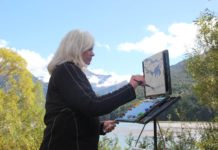
This Melbourne-based artist draws on her early Chinese art education to capture centuries-old objects en plein air.
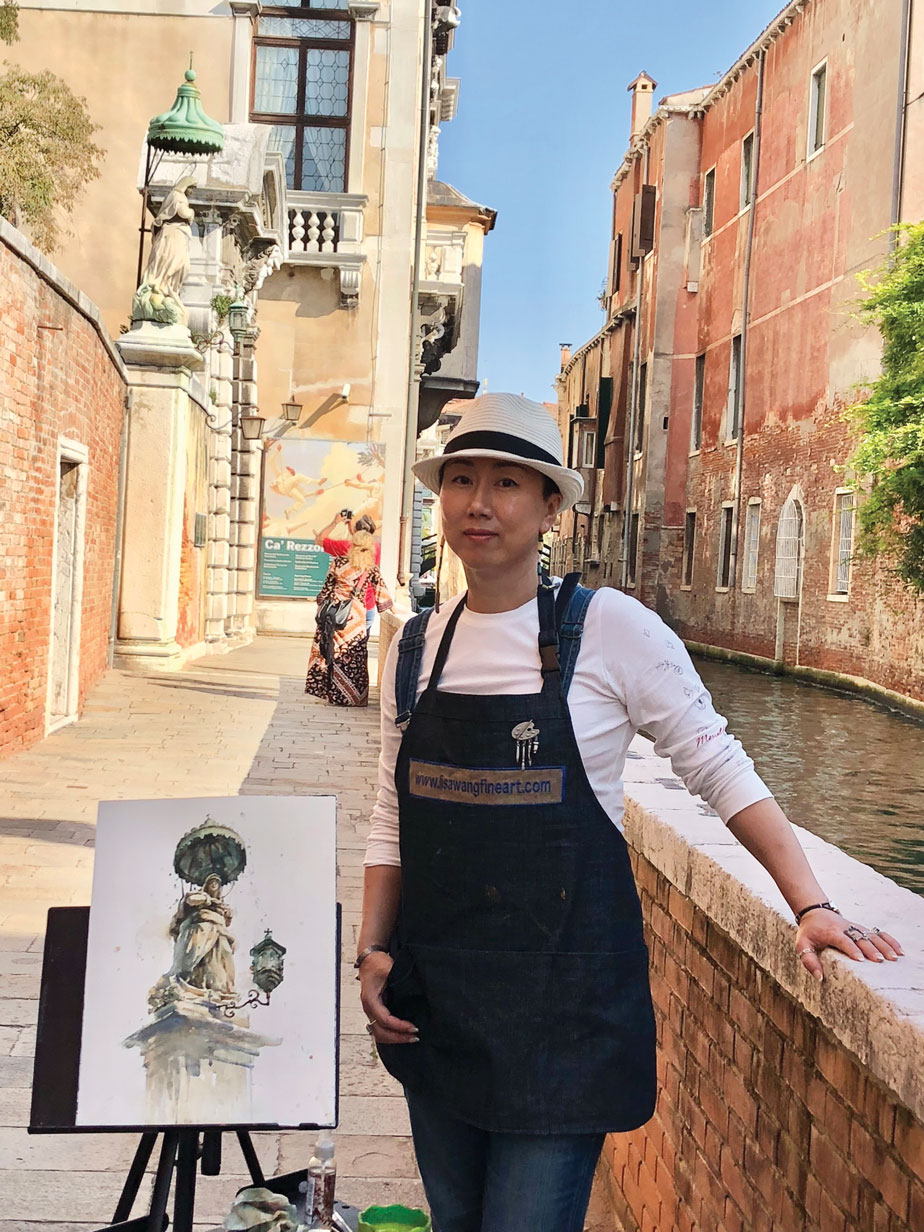
For Lisa Wang, watercolor represents a return to her roots. Although she spent more than two decades painting professionally in oil, her recent body of plein air work in watercolor represents a personal evolution grounded in rigorous training and a desire to capture spirit, not just form.
“I rediscovered watercolor nearly 10 years ago,” she says. “But my introduction to the medium goes back to my childhood in China, where I spent six years at a fine arts secondary school. We studied academic subjects in the mornings and art in the after-noons. The entire first year we weren’t even allowed to touch paint — it was all pencil and charcoal drawing.”
That early discipline shows in her work today. Whether she’s painting a sculpted door knocker in Barcelona or a historic monument in Venice, every composition is grounded in drawing. “I’m proud that I’m one of the artists who can use her bare hands to draw,” she says. “I don’t use a lightbox or digital tools. If you rely on those, you might as well use AI. The thing that makes a human different is our brain, our vision. That’s why I believe AI can never catch up to us.”
Favoring plein air when she travels, Wang says she leaves busy street scenes and broader architectural perspectives to her partner — renowned watercolorist Joseph Zbukvic — preferring to chart her own artistic territory. “I want to find my own voice, to make my own statement about Venice, Barcelona, or Boston.”
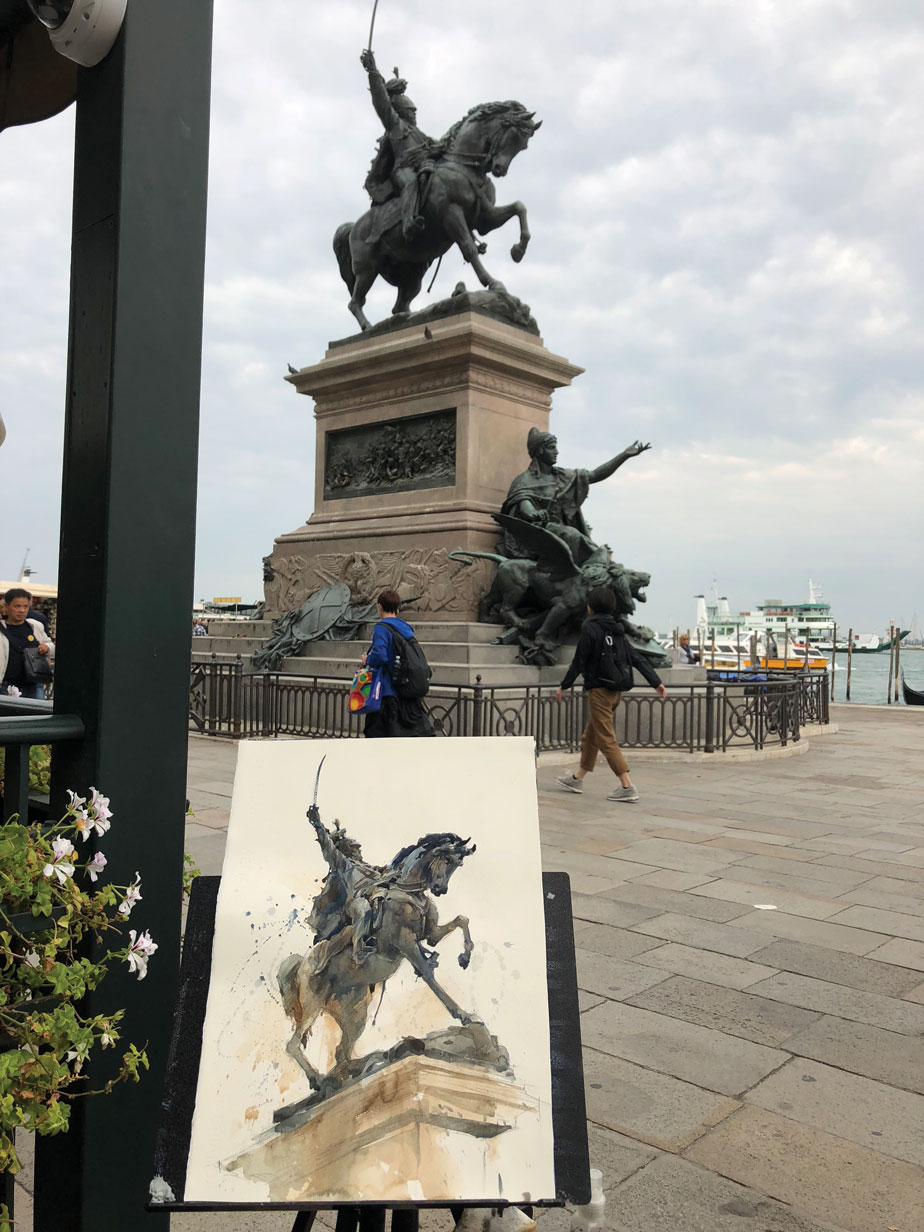
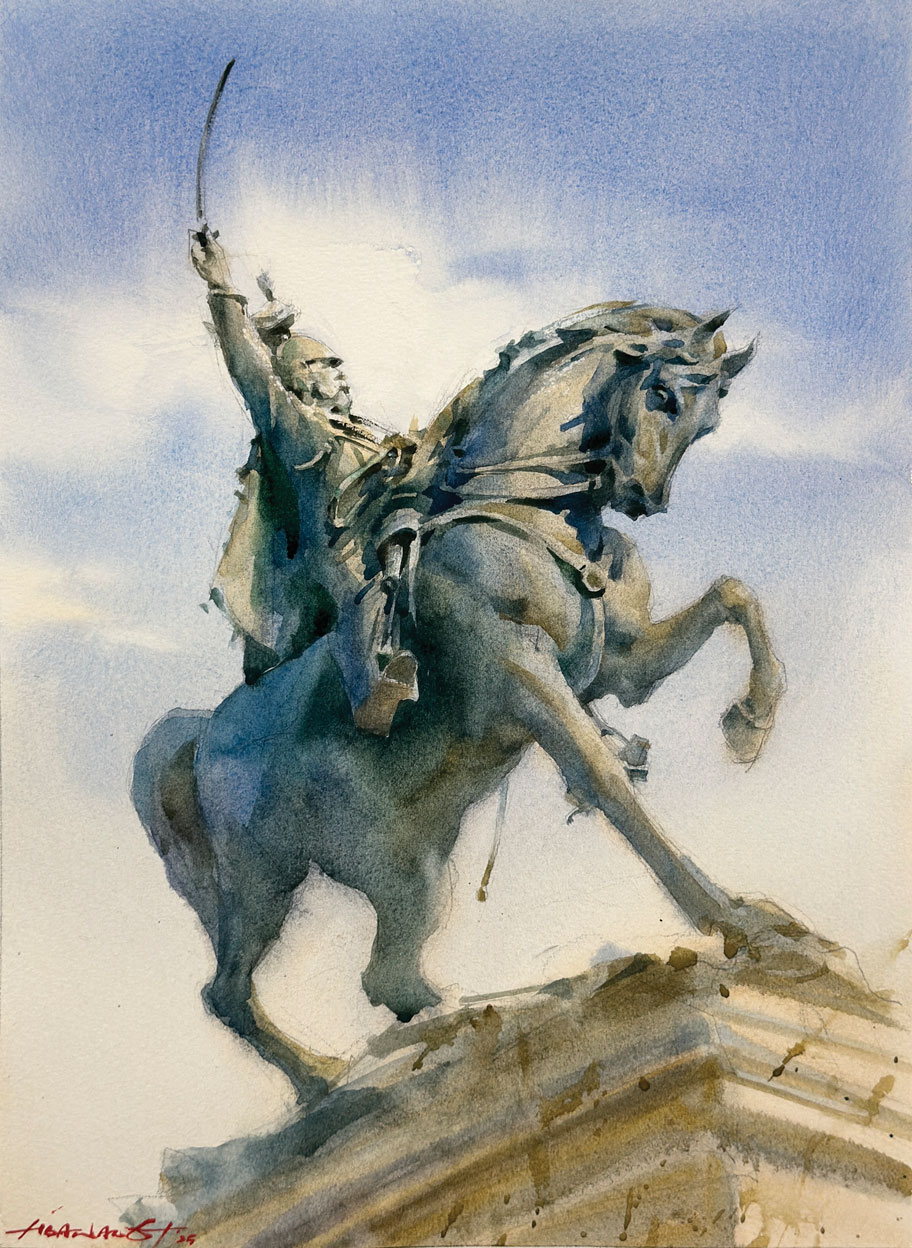
In fact, many of her plein air works have been created on location in Venice, where the city’s layered history offers an endless supply of sculptural subjects. She recalls one monument painted near the waterfront: “At the top sits a bronze statue of the man who unified Italy, King Victor Emmanuel II, on horseback with a drawn sword in his hand, inciting battle. I sketched and painted a quarter sheet on location, then had a beautiful lunch at a nearby restaurant. Later, I created a much more detailed studio piece from the study. The plein air version is sketchy and spontaneous. In the studio, I tried to infuse the work with the same energy by recalling how I felt on location as I refined the statue further and added sky as a background.”
At the base of the monument lie two allegories of the city. On the back, a battered female figure, representing “Subjugated Venice,” holds a broken sword. At her feet, a winged Marcian lion — a symbol of Venice, representing power and courage, and the city’s patron saint, Mark the Evangelist — bites the chains imposed by Austria. In the front, a personification of “Venice Triumphant” stretches her left arm forward, a sword resting in her right hand and a roaring Marcian lion at her side.
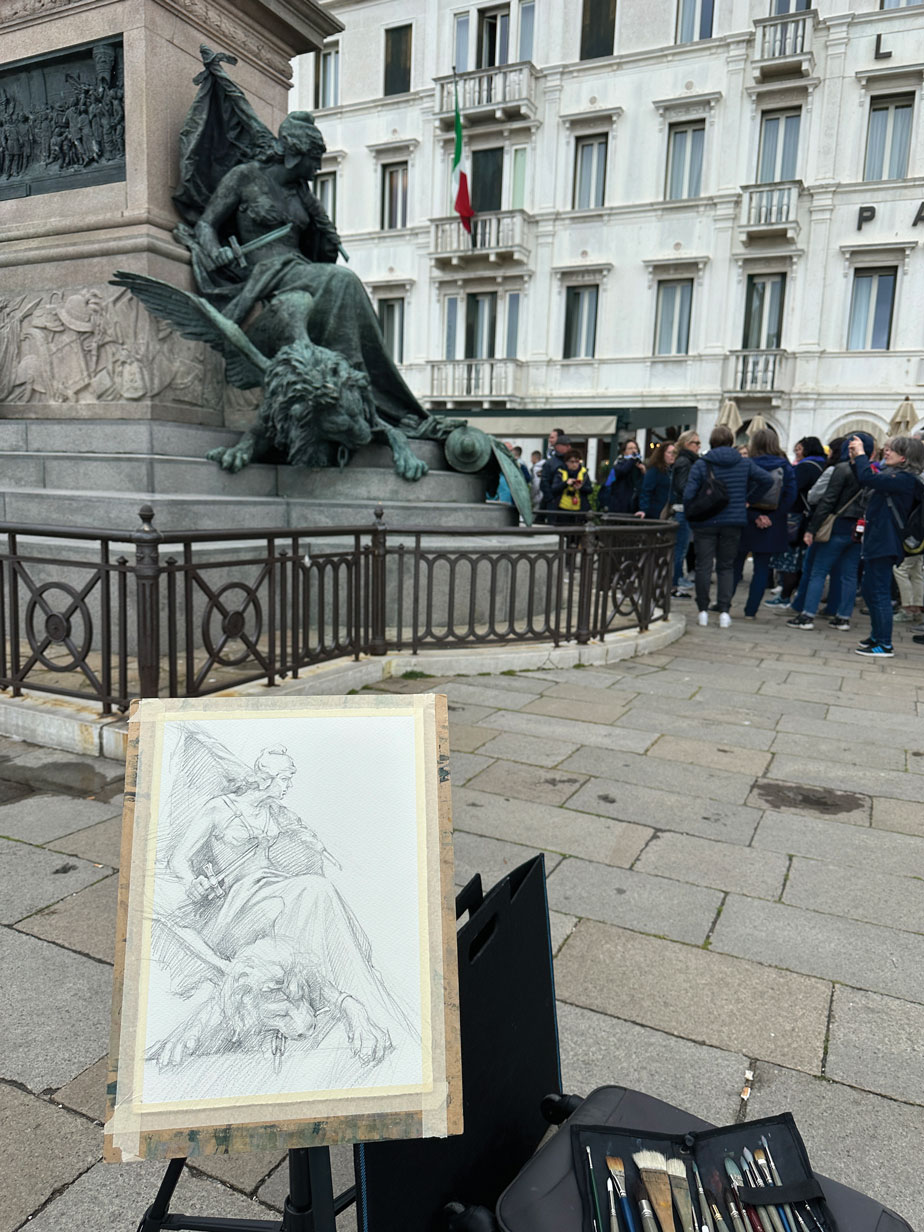
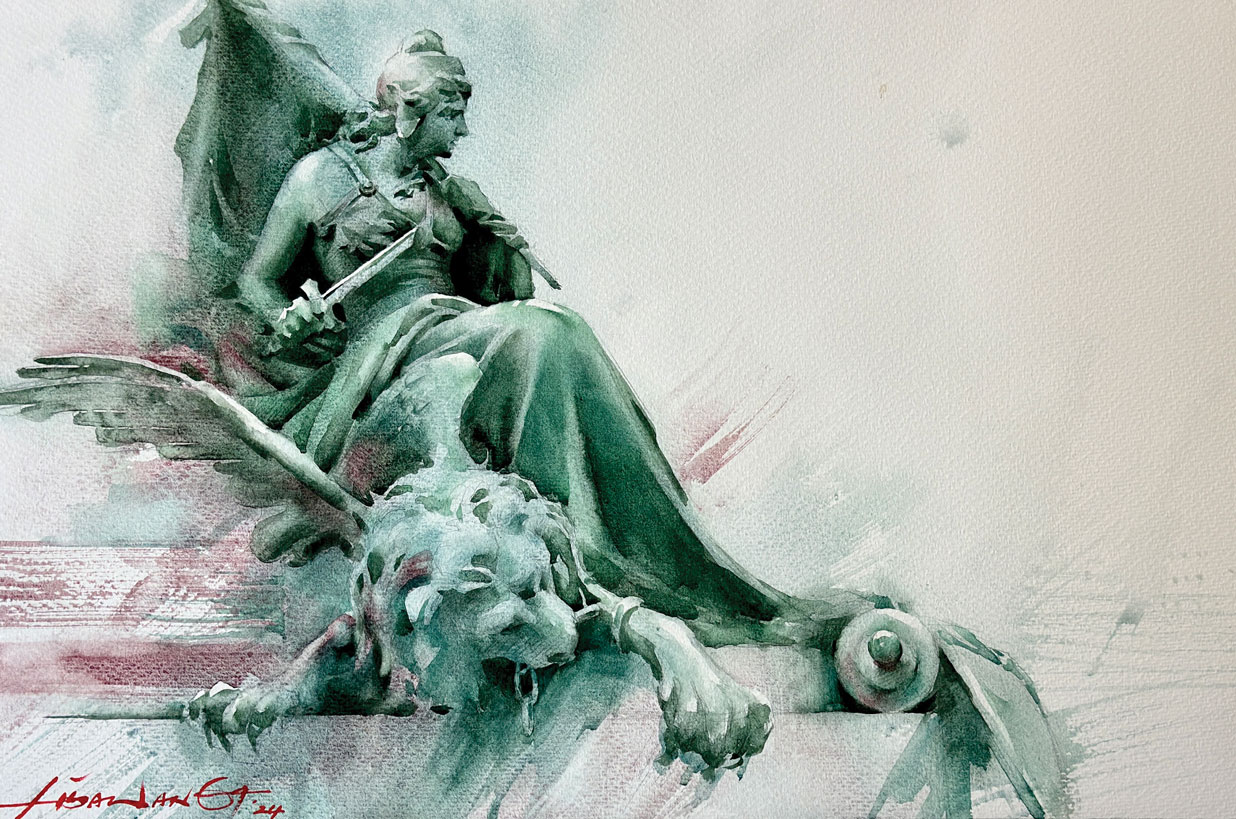
“I love the imagery of those female warriors and the lions,” says Wang. “I had just finished drawing the one on the back when it started to rain, so I had to go back another day to paint her. From the quarter sheet I did on location, I painted a half sheet at home in my studio — for that one I adopted a more horizontal format and changed my palette from the purples and greens I used in plein air to reddish pinks and greens. With every painting I do, I try to learn something new.”
Read the full article in PleinAir Magazine, August/September 2025 (download here)
Looking for MORE ways to improve your painting skills?
Don’t miss your opportunity to create lifetime memories at the Plein Air Convention & Expo! All training sessions are indoors on giant, high-def screens, with incredible paint-outs in the afternoons. Beginners and pros feel right at home, so register at PleinAirConvention.com to join us.
Browse more free articles here at OutdoorPainter.com
Story prepared for the web by Cherie Dawn Haas, Editor of Plein Air Today