

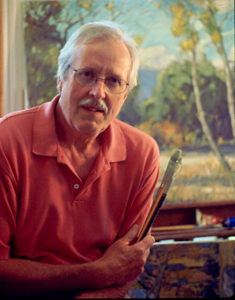
It is with great sadness that we announce the death of prolific plein air painter Karl Dempwolf, who passed away recently due to an accident. The art community is feeling the loss of this beloved artist and, in tribute to him, we’d like to share some of his iconic interviews and his 2017 PleinAir Magazine Lifetime Achievement Award presentation.
Let us begin with a short film that details Dempwolf’s childhood, adolescence, and adult life before highlighting his achievements as one of plein air’s most influential artists: his Lifetime Achievement Award.
Karl Dempwolf: Joy Over Product
A PleinAir Magazine Artist Profile (April/May 2017)
By Bob Bahr
“Did you get a good one?” Like many of us, Karl Dempwolf hears this question fairly often when he returns from a plein air painting session. And on one level, it puzzles him, because that’s not why he goes out into the field.
“Recently I was painting up a red rock canyon in the Mojave Desert, and someone was complaining about his 16 x 20-inch painting,” Dempwolf recalled. “He wasn’t happy with what he’d done. I said, ‘I’m rarely happy with what I’ve done, and that’s not why I’m out here. It’s about the process of sitting outside and just being in the process, being in nature.’ Now, if you ask me if I had a great morning, that’s different. The answer is that it was just wonderful. That really is the essence of it, right? Just getting out and sitting in nature and marveling at creation. It’s like I’m in heaven. You can’t tell that to some people. Some want a saleable item.”
Dempwolf said that the California Art Club has been crucial in returning plein air painting to its vibrant status, and for helping emphasize the joy and value of it. “The CAC had become a social club in the ‘50s, ‘60s, and ‘70s, and then Peter [Adams] put life back into it,” said Dempwolf. “He is the one who regenerated that fellowship that artists have when they go paint together. All of us are out there painting the same thing — differently. It’s just wonderful. It’s like a natural high. The process is the thing, and I think others feel the same way.”
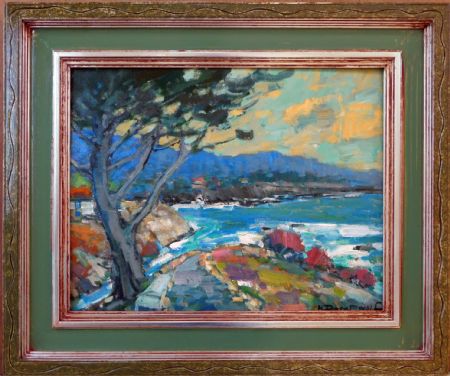
Sure, plein air painting is a challenge for Dempwolf, as it is for nearly everyone. But it’s clearly a joy, nearly carefree. He doesn’t even feel compelled to adhere to the scene he’s depicting. “People always ask, ‘Where is this?’ They won’t figure it out unless I write the location on the back,” he said. “I make changes to the scene depending on what I want to create. Making facsimiles is not what I want to do. Whenever I get too close to reality, I change something.
“I really do feel that when I am out there getting the paint down, I am in church. This is my religious service. It’s a spiritual thing. It makes me feel whole. In the studio, oh lord, that’s when it becomes work. I have to make something deeper with it there. In the studio, it’s a real job; I’m struggling with something that I hope turns out well.”
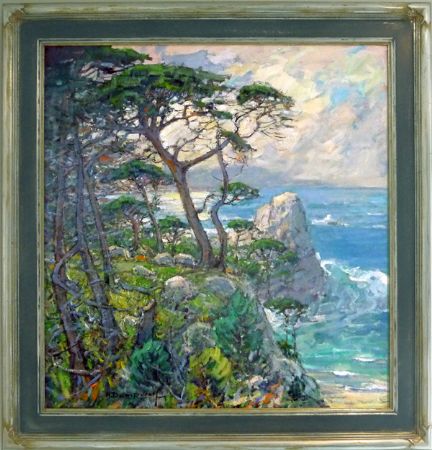
“I am always curious about what’s around the corner,” he says. “I want to finish and go see if there’s a more beautiful vista right around the corner. With a smaller painting, I can get done more quickly.
“Painting small en plein air is important to me for several other reasons. The larger paintings I paint on location don’t look like my work — the smaller paintings look like how I want my paintings to look. I sit there and go through the process with my little pochade box and 5 x 7-inch panel — or a piece of plywood, or even prepared cardboard. And still, when I come back to the studio and look at the little sketches I’d done, I’m sometimes like, ‘Oh, man, I’m glad nobody saw this piece,’ or, ‘I need to go back into this study because I know what I saw, and this doesn’t capture it.’
“Copying nature on that scale is almost an impossibility. But that’s good. I end up painting the big shapes, the design that I see. The smaller format makes you synopsize what’s in front of you. You have 35 square inches in which to put stuff, and you have all that grandeur in front of you. So you end up focusing on four or five major masses. There’s no detail — there’s no room or reason for that.”
“If I see a compositional error, I will say something,” Dempwolf said. “If there’s a problem with color harmony, I will speak up. But I create my own reality. So when it comes to others, I think, who the heck am I to say how they should paint?”
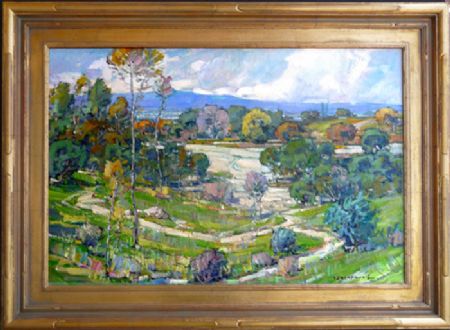
Dempwolf’s way to paint is distinctive, in part because of his palette. The California painter’s work has a lot of strong color in it, and that is only increasing these days. “The range of my palette, my values, has changed in the last five or six years,” said Dempwolf. “I’ve gotten punchier in my colors; my chroma has intensified. The range is much bigger than it was —it used to be much closer. There’s just more contrast, more lights and more darks.
“In general, I try to break out of whatever box I’m in. I’m wary of similar colors or similar brushstrokes. For example, look at some of the colors for California live oaks. Live oaks have warm brownish buds on them in spring that makes the color of the tree less green and more orangey. Summer means lots of browns in the hills, and in the foreground grasses. And I feel I have to put some orange in there to pop the greens. Maybe I didn’t see the really orange oranges that I laid down. I have added color that is not there. I need to do that or I have brown and green paintings, and I feel I am missing a color. I change the colors all the time — and the shapes, until it works for me.”
Dempwolf sees precedent for this in the work of some California impressionists he admires. “When I look at a Wendt or the work of some others in that group, I wonder, is this what they actually saw, or did they manipulate it to get the harmony that is in their paintings? I wonder about it. And then I think about the colors in New England that I saw that were so radical. I wonder if someone would be interested in a painting that shows the red that I see in a tree. To me, it’s wonderful.
“All those impressionists massaged and manipulated color, I assume. Sometimes they’d come clean — Wendt told a newspaper that he was explaining to a poet in Laguna, ‘Those hills in the background of the painting? The hills are from another area, but they were needed in this painting. Twachtman, Ritschel, Hassam — maybe they all moved things around to make a wonderful painting.
“Whenever I pull out an old painting, I snap it up a bit,” said the master. “I add more brushstrokes, more contrast to make it contemporary for me.” [PleinAir Magazine, 2017]
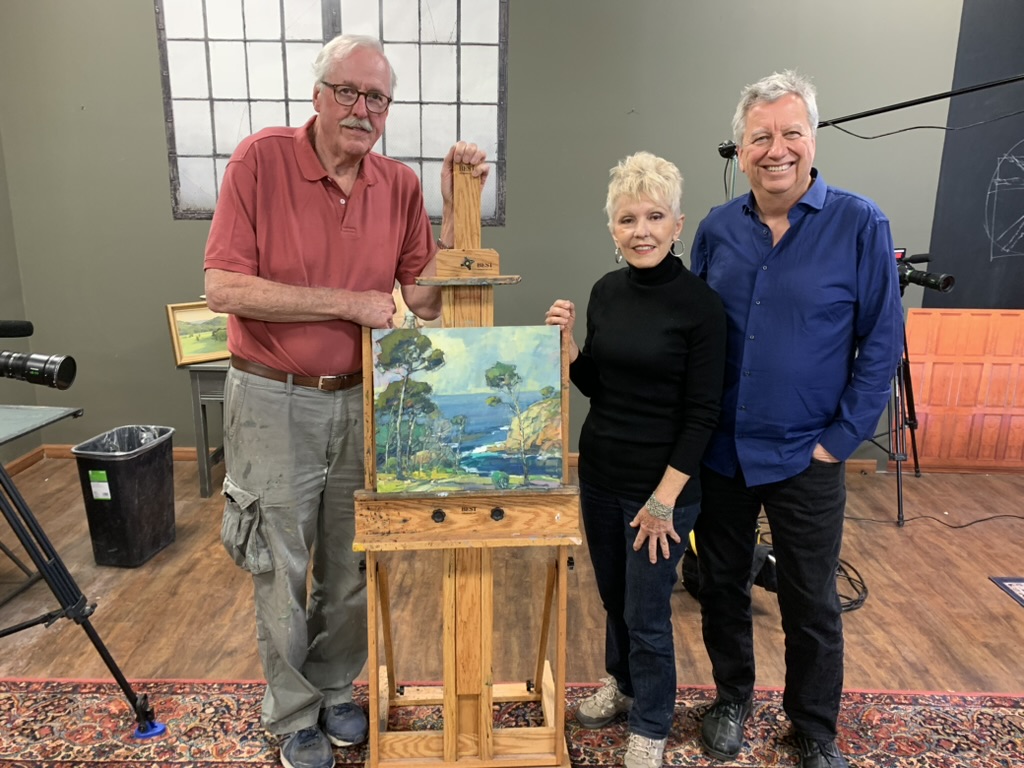
Karl Dempwolf on the Plein Air Podcast with Eric Rhoads:
“Karl was an incredible, talented artist whose work reflected the style of the impressionists at the turn of the century, and he was a gem of a guy,” shared Eric.
We invite you to share your thoughts in the comments section.
Compiled by Cherie Dawn Haas, Editor of Plein Air Today

How sad, we’ve lost a talented giant in the Plein Air movement and in the world of art.
I took a plein air workshop with Karl and his love of painting and enthusiasm was inspiring. He started me on my artistic journey and opened my eyes to the unending beauty of the landscape. I owe him. Thank you Karl for all your generosity with you knowledge and encouragement along the way.
Karl Dempwolf was a huge support to SCAPE, our plein air group in Santa Barbara. He gave workshops, judged shows, and was so moved the first time he did that he gave the proceeds of sales of his paintings to SCAPE. He shared and created joy around him, and will be remembered and deeply missed.
I have admired Karl’s work for years and its a great loss to our art community. Great artists continue to inspire each other and Karl’s work was just beautiful and I continue to work to achieve great art that I can pass on to others
I never formally met Karl. I saw his work and occasionally saw him at a CAC event. Hi work was wonderful and very expressive. We will miss his talent.
Karl and I were among the tallest in our class at Van Nuys High and we became acquainted during the making of our class photograph in about 1958. We got to talking about classical music, and as I had tickets for the Hollywood Bowl concerts, and none of my friends were interested, I asked Karl if he’d like to go along with me. So we attended a couple of the concerts together. I remember Karl naming the orchestra’s tuning- up “The Spaghetti Symphony” and calling Dvorak’s “New World Symphony” “Porky’s Farm”.
During our conversations Karl expressed an interest in art, too, even though he had not yet seriously taken up painting.
Fast forward: I received a Fullbright grant for Germany in 1968, met and married a German artist. One day, as I was surfing on Facebook, I discovered that my old classmate, Karl Dempwolf, had become a successful artist in California. We had some fun correspondences on Facebook.
And suddenly, recently, he was no more: How sad for all who knew him.