
As a plein air artist, you are part of one of the largest art movements in history. In this “plein air heritage” series, learn about those who have helped start this movement in some way, and be inspired to continue your own journey of landscape painting. For even more inspiration, subscribe to PleinAir® Magazine.
Jean Honoré Fragonard (French, 1732–1806)

Rediscovered more than 25 years ago, this small plein air oil sketch sheds light on a little-known aspect of Jean Honoré Fragonard’s practice. Described as “a quick response to nature, as if the artist were recording an impression glimpsed from a carriage window as it rolled through the countryside,” it confirms that although drawing en plein air was well established by the mid-18th century, the artist was an early adopter of painting full-color aides memoires outdoors.
Beginning with paper prepared with a thin white ground, Fragonard quickly outlined the major forms, using black chalk or crayon. He then thinly brushed in the foreground and the masses of trees with oil, returning with thicker brushstrokes to add volume and character to the foliage. The mountain range at the lower center and the cloudy sky were painted with broader, more opaque passages, with the blue of the sky at times describing the contours of the dark green trees.
Despite the obvious spontaneity of the study, the artist took care to compose the scene, balancing the heavy mass of trees at the right with smaller bushes and clouds at the left.
John Constable (British, 1776-1837)

A student of the sky, John Constable felt that a thorough understanding of the formation of clouds, their influence on the quality of light, and their contribution to atmospheric effects would give his landscapes greater truth.
In the early 1820s, he lived in Hampstead, a village situated just north of London on an open, hilly heathland that gave him the perfect vantage point to study the sky and its ever-changing effects. It was during his residence there that he made many oil sketches of the sky, working on paper en plein air.
Typical of his Hampstead sky sketches, “Cloud Study: Stormy Sunset” (above) vividly conveys the effects of light, atmosphere, and movement on a cloudy evening after a stormy day. Working quickly to capture his subject, the artist brushed on color with gusto, wet into wet.
Although he considered these studies research material gathered in service of exhibition pieces to be completed in the studio, they took on added significance as his art became more emotionally charged toward the end of his life.
He increasingly regarded the sky as “the chief organ of sentiment” in landscape painting, and likely looked to his cloud studies more for their expressiveness than for their empirical or scientific content.
He referred to the exercise as “skying,” often annotating the studies with the date, time of day, wind direction, and scientific description of the cloud formation depicted.
Peter De Wint (British, 1784-1849)

Intended to follow in his father’s footsteps and become a physician, Peter De Wint instead pursued his love of art, taking an apprenticeship with the engraver and portrait painter John Raphael Smith. Four years later, he purchased his release from the position with the promise of 18 landscape paintings in 24 months’ time.
From there De Wint would go on to hone his skills under the tutelage of Dr. Monro, a well-known patron of young artists, who admired his sketches. A course of study at the Royal Academy schools a few years later cemented his reputation as a painter. And although he worked extensively in oils, he became best known as one of the finest watercolorists of his generation.
A short visit to Normandy in 1828 marked De Wint’s only journey abroad. As a result, his work is almost entirely devoted to the English countryside. Distinguished by broad washes of deep color and a strong sense of light and shade, his paintings, such as “Waterfall in the Dingle at Badger Hall” (above), were prized for their fidelity to ordinary aspects of nature, which he painted directly in the open air.
Jean-Baptiste-Camille Corot (French, 1796-1875)
For any European painter of the early 19th century, the Italian landscape held an almost mystical appeal, luring the likes of a young Jean-Baptiste-Camille Corot (1796–1875) with its natural beauty and antique monuments. The candor, naturalism, and seemingly intuitive structure of this sketch, made during his first trip abroad, attest to the artist’s mastery of plein air to capture the country’s marvels.
Although Corot didn’t exhibit informal works like this one, he tried to infuse the paintings he began to show at the Salon the next year with the same vigorous sensibility. Back in France, he settled into an annual routine of travel and plein air sketching in spring and summer, followed by winter work in the studio to elaborate his sketches into exhibit-worthy compositions.
Too old to be directly associated with Realism or Impressionism, the artist provides a transition from the sharp academic style that ruled in his day with his focus on the natural world and the lyrical expressiveness of his work. His students, including Camille Pissarro and Berthe Morisot, often credited Corot’s plein air techniques for teaching them how to capture their own emotional responses to a natural setting.
Thomas Fearnley (1802-1842)
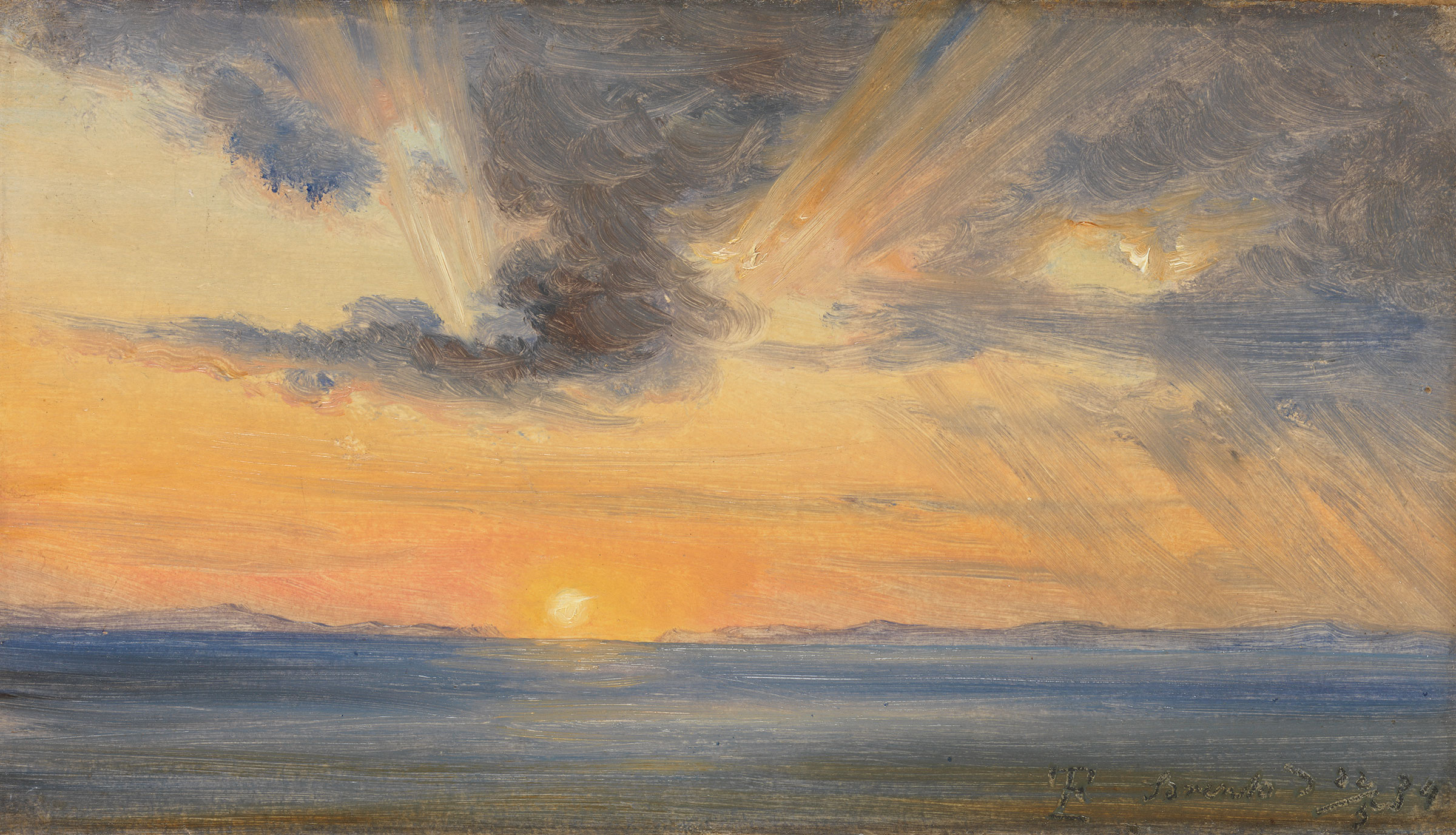
Like his mentor and fellow Norwegian, Johan Christian Dahl, Thomas Fearnley (1802–1842) alternated between large, composed landscapes meant for exhibition and smaller, plein air oil sketches. They parted ways, however, when it came to subject matter. While Dahl urged him to specialize in local landscapes, Fearnley preferred to travel and sketch widely throughout Europe.
With its bright, small sun at the center emphasizing the fleeting quality of the moment, and the stark lines in the clouds hinting at the oncoming darkness, “Sunset, Sorrento” illustrates the attention the artist paid to the role of light in his studies.
Upon the artist’s death at age 39, this sketch and myriad others surfaced. Although Fearnley considered them incomplete works, Dahl argued they were “better than his finished paintings, for in them he gave of his true self, as he was and as he felt when face-to-face with nature.”
If not for Dahl’s encouragement of the Norwegian National Gallery to acquire these sketches from Fearnley’s widow, the public may never have enjoyed this revealing glimpse into the personal work of one of Norway’s most important artists.
Richard Parkes Bonington (1802-1828)
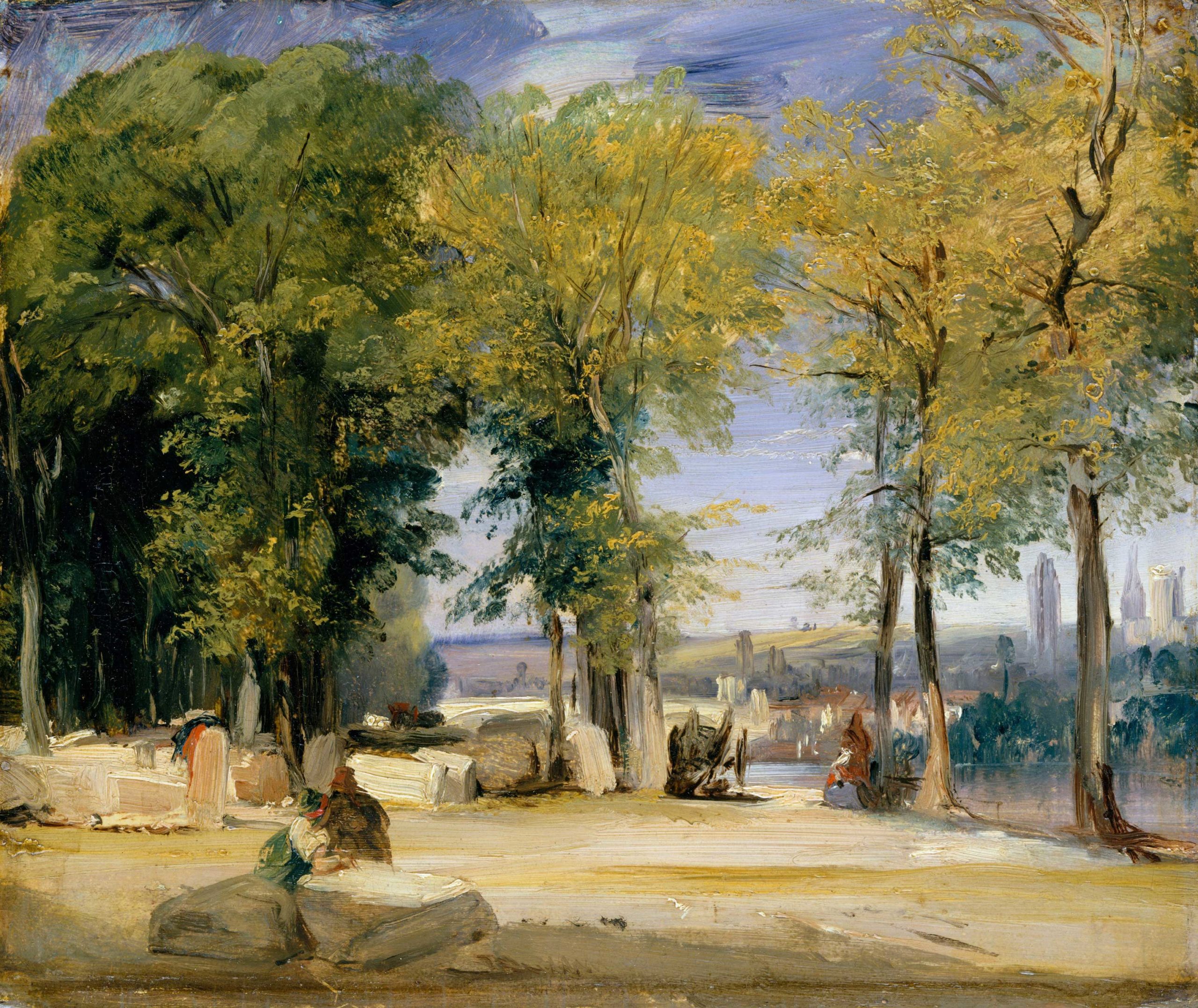
Born in England but trained in France, where he spent most of his life, Richard Parkes Bonington enjoys a place in the history of both British and French art. Characterized by bright color, delicate brushwork, and a fresh naturalism, his landscape paintings often feature river scenes or views of the French coast.
For “View Near Rouen” (above), he painted from the bank of the Seine opposite Rouen, likely in the late summer or autumn of 1825, shortly after returning from London, where he’d been inspired by the work of the great English landscape painters John Constable and J.M.W. Turner.
Preferring to paint directly from nature, Bonington had walked away from the École des Beaux-Arts and the tutelage of Antoine-Jean Gros (French, 1771–1835) years before. Although he enjoyed great success in the master’s studio, he grew bored with drawing from casts in the academic tradition and set out on his own path of study, which included a sketching tour to Normandy.
Although Bonington’s career spanned less than 10 years, his approach to landscape painting had a profound influence on the Barbizon School, and later the Impressionists, including Claude Monet.
He represented an important bridge between English and French landscape painting and was instrumental in launching the French plein air tradition. He died one month before his 26th birthday, from a complication of tuberculosis.
Alexandre Calame (Swiss, 1810–1864)
A devout Calvinist, Alexandre Calame (1810–1864) saw the large-scale, dramatic Alpine scenes he was known for as expressions of the divine. At their core, however, the paintings demonstrate the artist’s deep natural connection to the land.
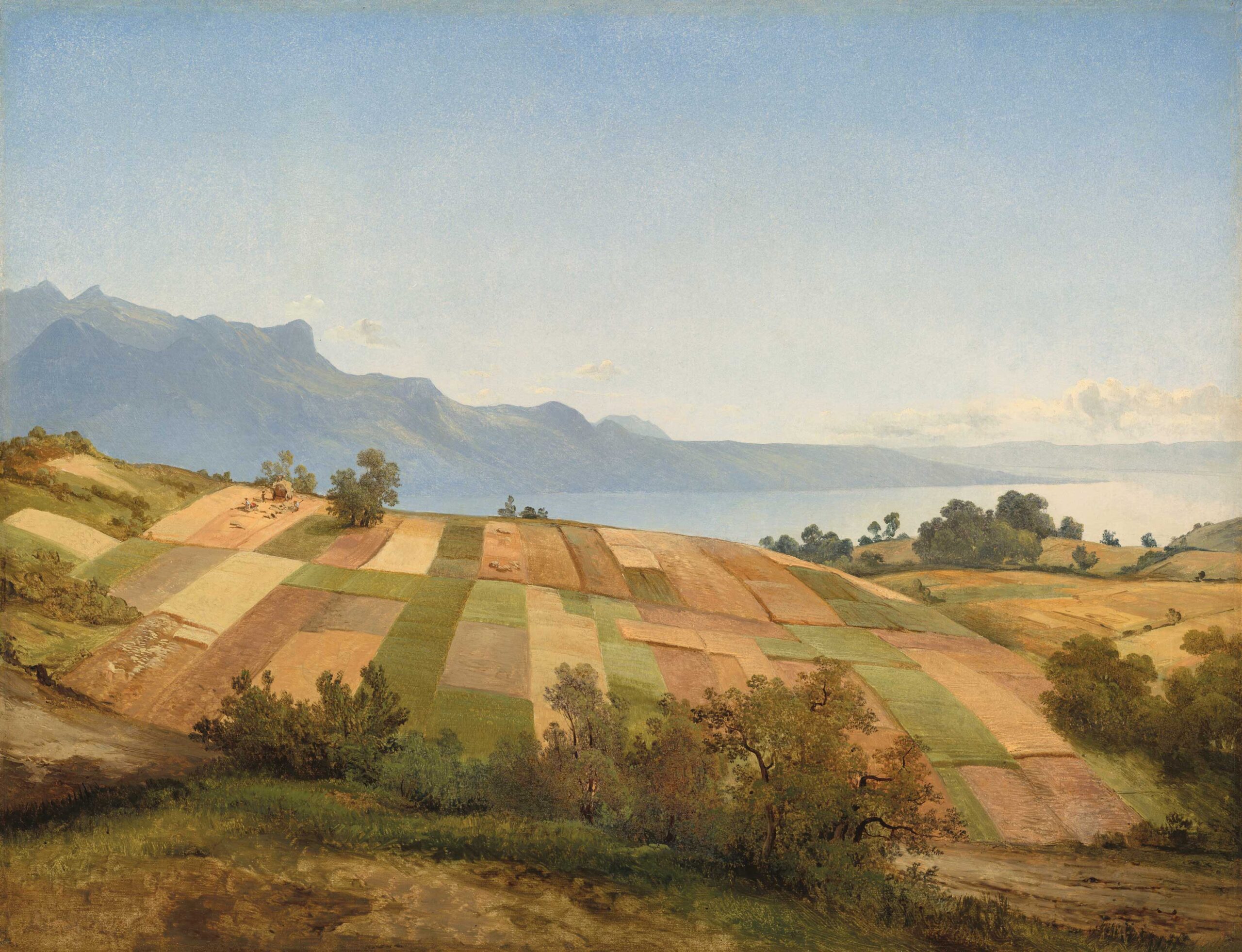
As a committed member of the Düsseldorf school of painting, Calame advocated working en plein air. At his death, nearly 600 small paintings and studies never meant for public view were found in the artist’s studio. Among them, “Swiss Landscape” (shown above).
In this piece, Calame eschews the scenes of snow-capped peaks that dominate his oeuvre in favor of a quieter view of the landscape. Rather than forbidding and awe-inspiring, the effect is warm and inviting. A group of harvesters toil among the fields — a neat patchwork of greens and golds. The mountains and lake have been simplified into shapes of color, echoing the geometry of the landscape. Here, the artist does not celebrate the power
of nature, but rather its quiet, subtle beauty bathed in a gentle light.
Johann Jakob Frey (Swiss, 1813–1865)
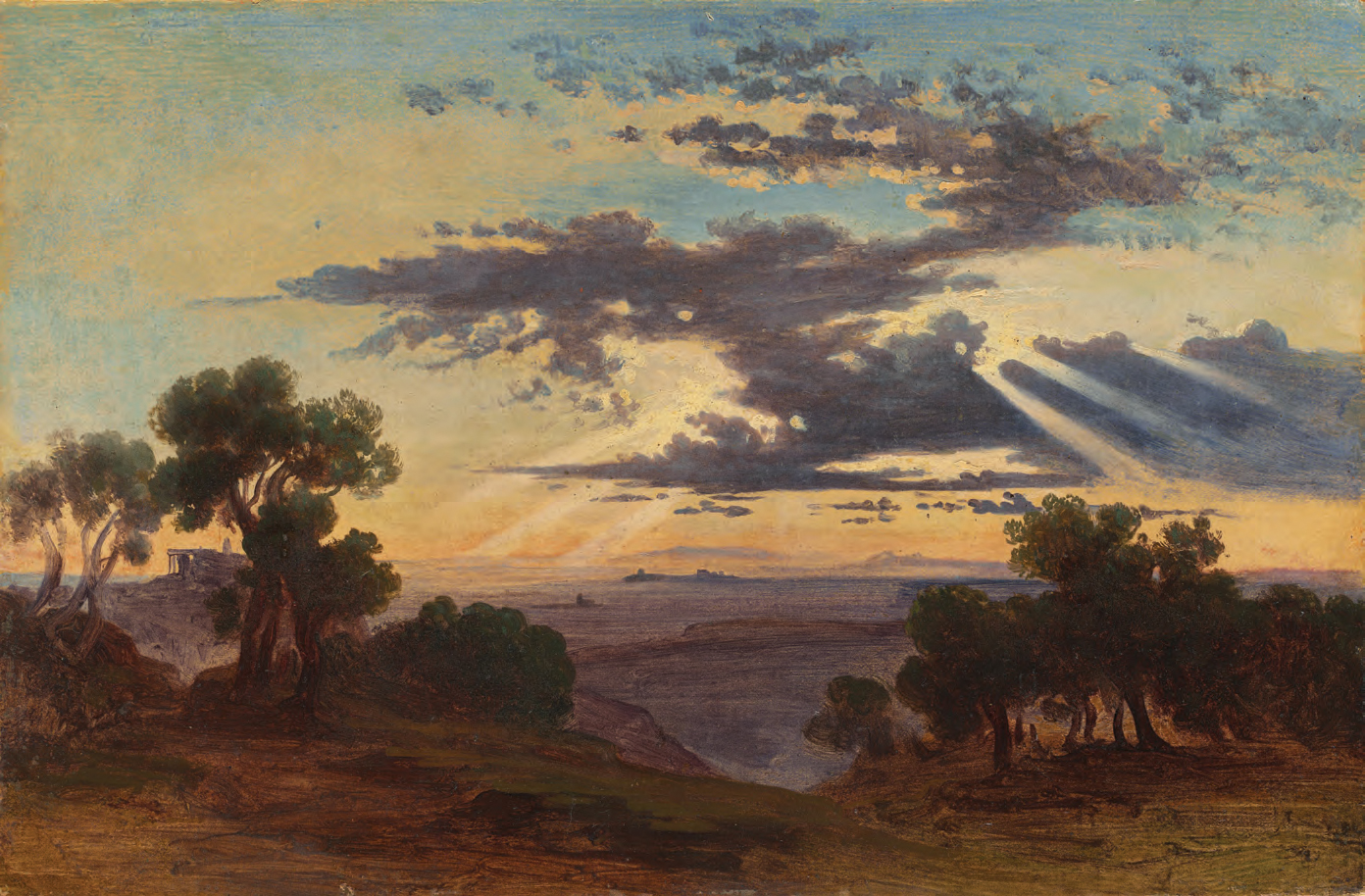
Born in Switzerland and trained by his father, a lithographer and draughtsman, Johann Jakob Frey (Swiss, 1813–1865) spent time in Munich and Paris before settling down in Rome. As preparation for large, highly finished paintings, he made numerous sketches and drawings from nature. Of these, his sky studies stand out, mainly for their bright palette and the remarkable depth he achieved in his clouds.
In such works, the ground remains minimalistic; often he used only two or three long brushstrokes to suggest a plane. Inspired by trips to Egypt, Nubia, and part of Sudan, he incorporated accents of purple, yellow, and pink — hues not seen in the Italian sketches of his contemporaries. Despite their quality, these private works remained hidden by the artist until his death.
Eugène Louis Boudin (French, 1824–1898)
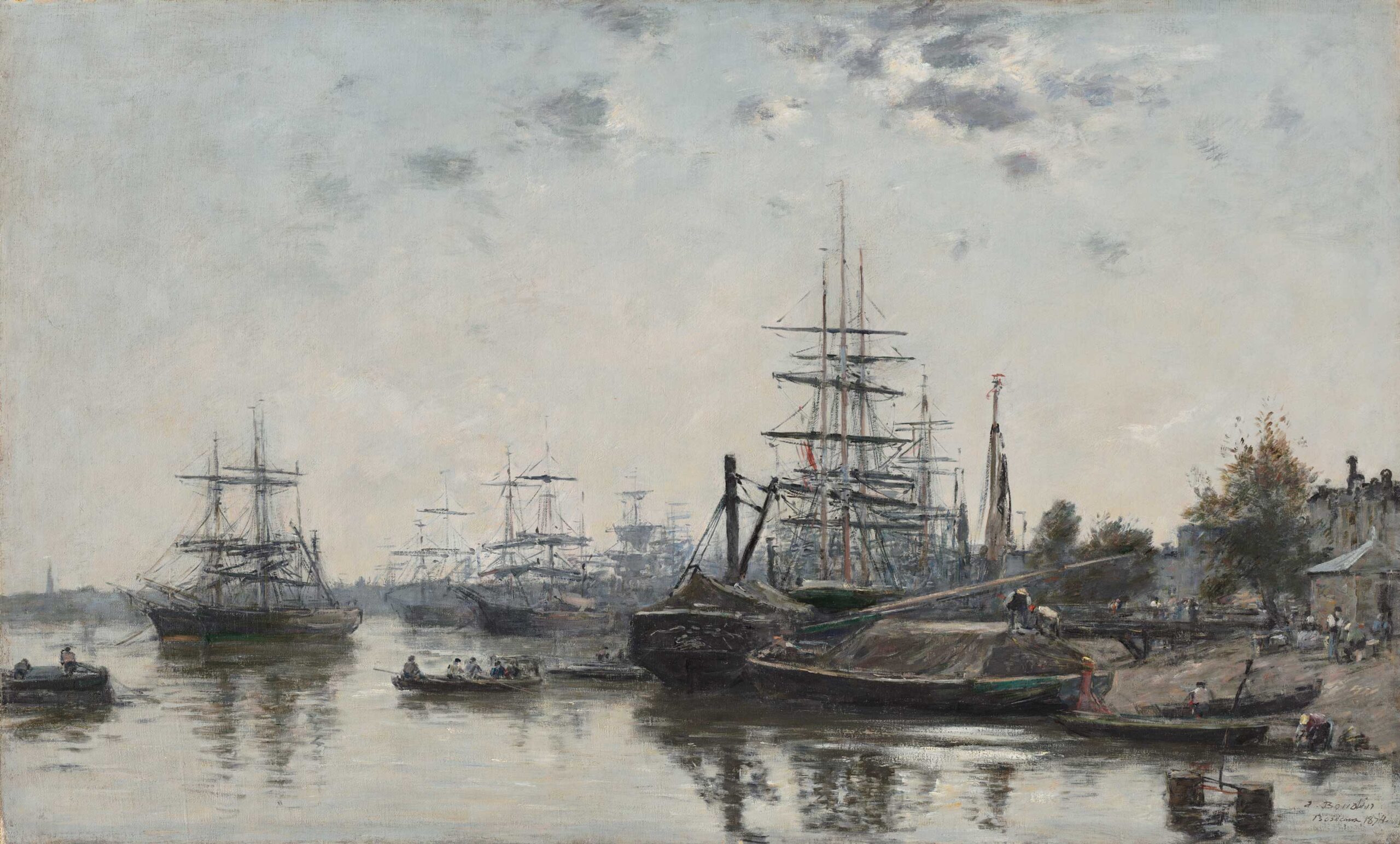
The son of a sailor, Eugène Louis Boudin (French, 1824–1898) grew up near the sea in Normandy. While he enjoyed only a brief stint as a cabin boy at age 11, ships and harbors remained a muse for much of his painting career. Largely self-taught, the artist found the best way to capture the subtleties of such scenes was to paint outdoors. He was so enthusiastic about the practice, in fact, that he often documented the weather and time on the back of his canvases.
Here, he concentrated on the working docks of Bordeaux. The low horizon line relegates much of the canvas to sky, with the soaring vertical and diagonal forms of the masts providing a complement to the horizontal thrust.
To create a fresh, airy quality, the artist covered the entire canvas with a tan color, then, probably while it was still wet, applied a thin, opaque application of white. For the darker areas representing water, he laid in an olive green.
Considered one of the forerunners of French Impressionism, he shared his love of plein air with a young Claude Monet. “You must be absolutely determined to retain the first impression, which is the correct one,” Boudin told his protege.
Monet acknowledged later, “My eyes, at last, were opened. If I have become a painter, it is entirely due to Eugène Boudin.”
Frederic Edwin Church (1826-1900)
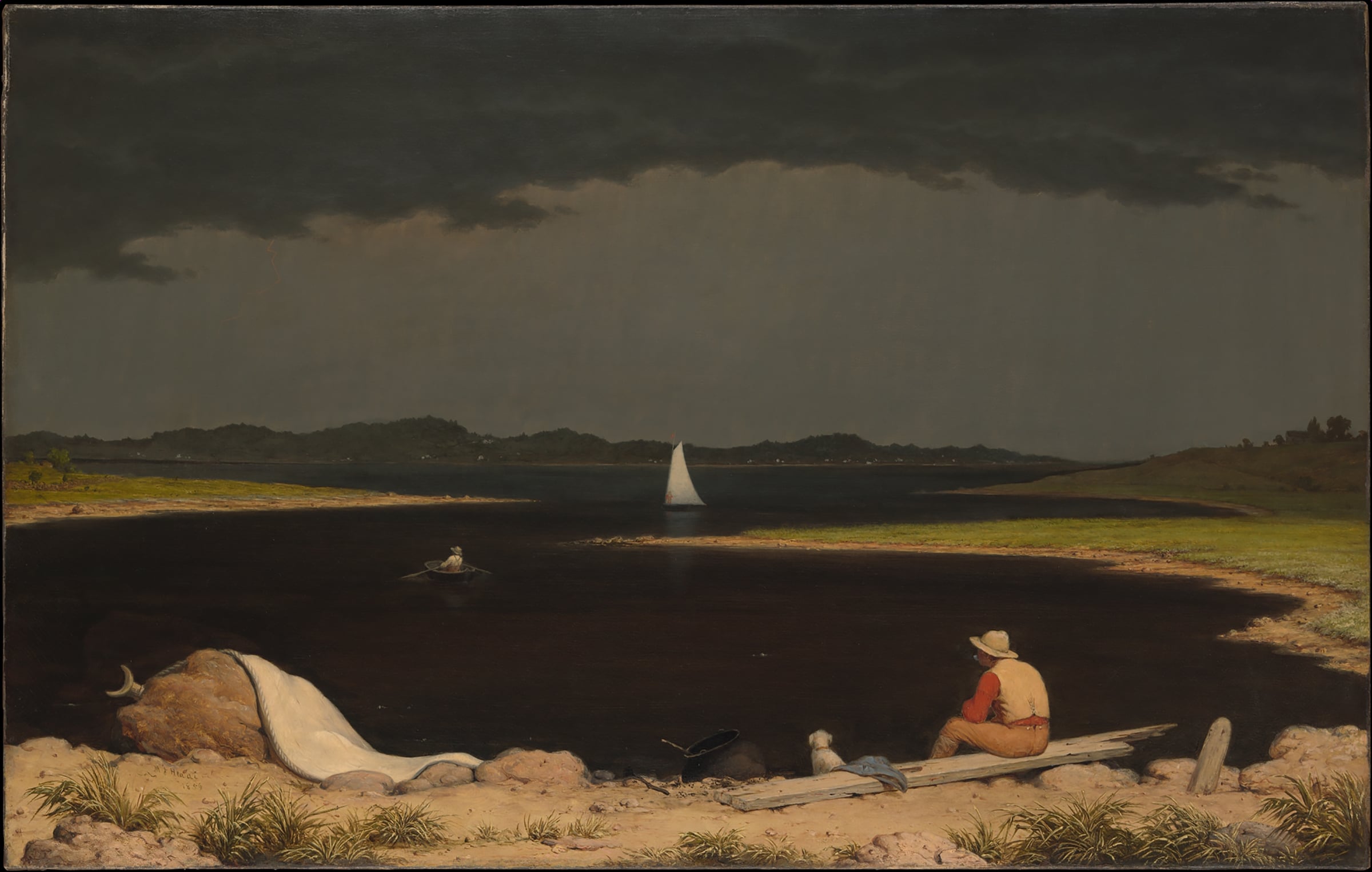
Although he kept a studio in the same building in New York City as several artists of the Hudson River School and became good friends with Frederic Edwin Church (1826–1900) — one of its most celebrated members — Martin Johnson Heade (1819–1904) operated on the fringes of the movement.
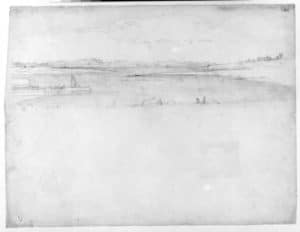
His paintings exhibit the same influence of Romanticism, but while his building-mates turned to the wilds for inspiration for their majestic depictions of mountains, valleys, and waterfalls, Heade opted for decidedly more horizontal expanses of subdued scenery — primarily salt marshes and coastal settings, from Massachusetts to New Jersey.
Even when he painted storms, a favorite subject, he preferred the somber buildup to the main event. Here, rather than the tempest itself, it was its prelude — the blackening sky and eerily illuminated landscape — that inspired the artist to capture the scene he witnessed on Rhode Island’s Narragansett Bay in a sketch, which provided the basis for this painting.
Camille Pissarro (1830–1903)
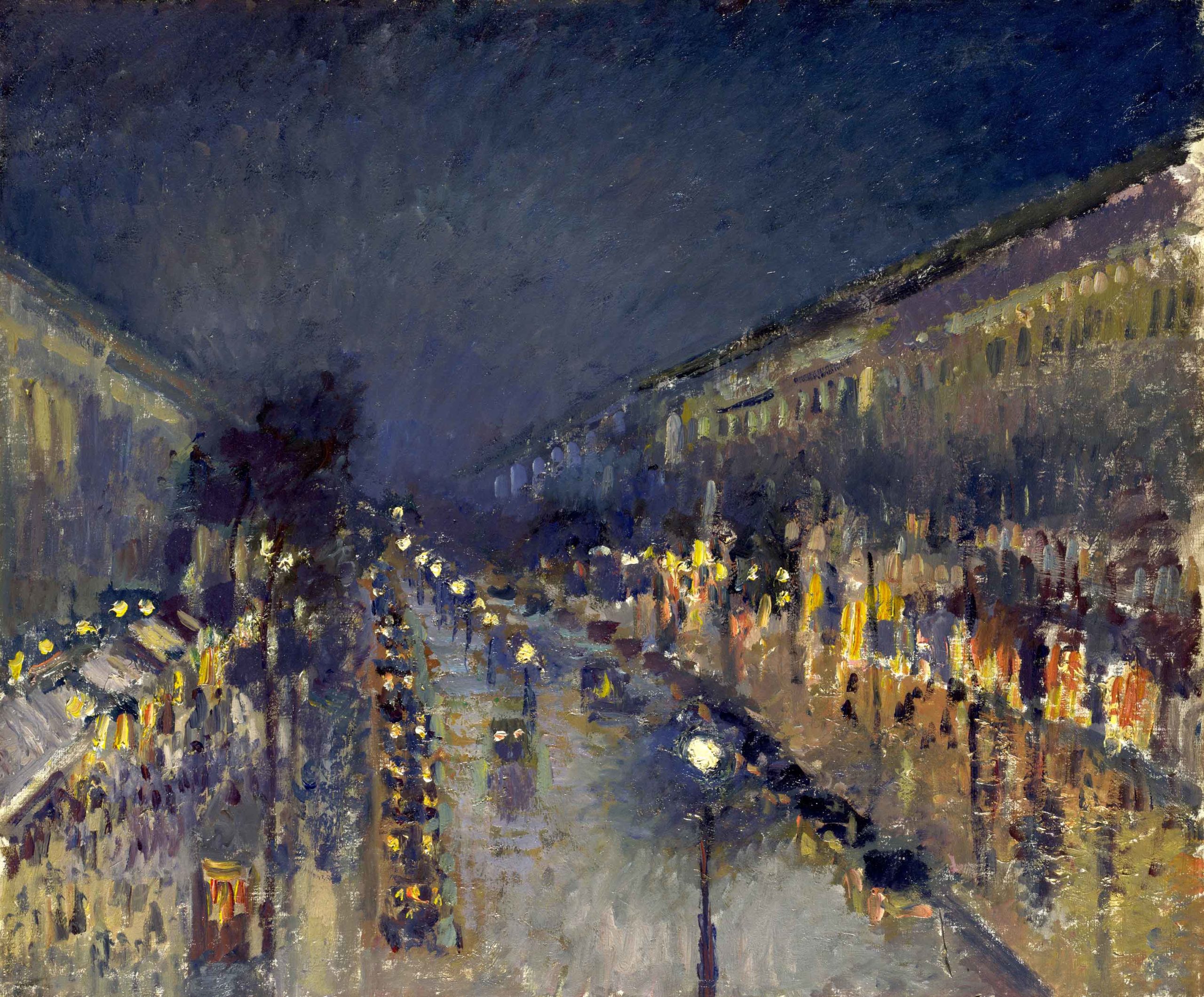
Inspired by Camille Corot and Gustave Courbet, Camille Pissarro often fled the hustle and bustle of Paris to paint the countryside. Like many of his contemporaries, he preferred to paint in the open air, but while others chose to complete their work in the studio, Pissarro finished his outside.
In later years, the artist suffered from a recurring eye infection that prevented him from working outdoors much of the year. He spent more and more time in the city, often renting apartments or hotel rooms, where he painted views of the urban landscape from the windows.
In February 1897, he took a room in Paris at the Hôtel de Russie on the corner of the Boulevard des Italiens and the Rue Drouot, and produced a series of paintings of the Boulevard Montmartre at different times of the day. This painting is the only night scene of the series, and offers a masterful portrait of the modern city.
Created at a time when easy access to artificial light was still new, Pissarro’s repeated patterns of flickering carriage lights and street lamps provide a magical look at the City of Lights as it defies the encroaching, isolating darkness.
Edouard Manet (French, 1832-1883)
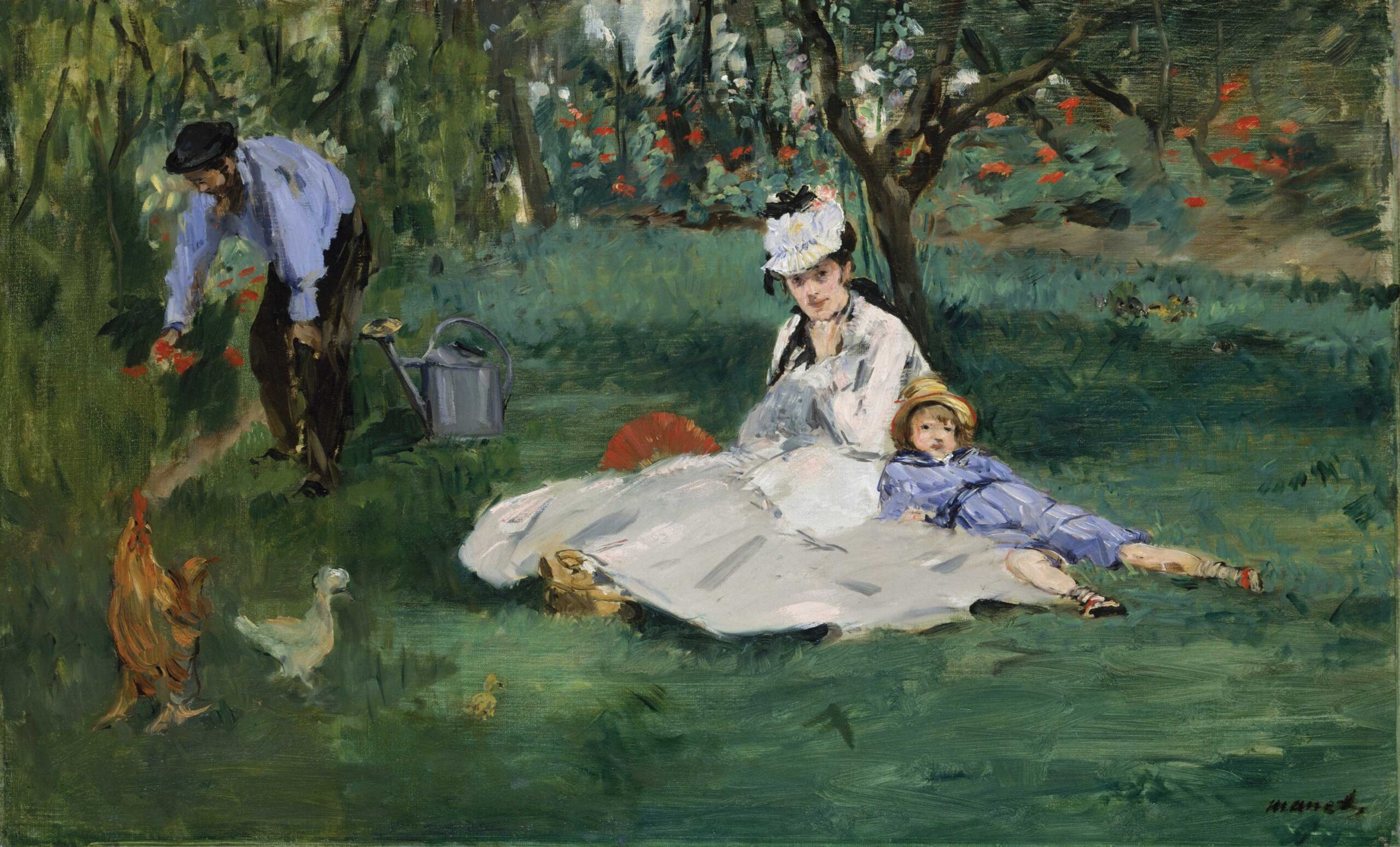
In the summer of 1874, Edouard Manet vacationed at his family’s house in Gennevilliers, just across the Seine from Claude Monet at Argenteuil. The two saw each other often, and on a number of occasions were joined by fellow painter Auguste Renoir.
On one such visit, Manet made this painting of Monet tending his garden with his wife, Camille, and their son Jean lounging nearby. Just as Monet was setting up to paint Manet at his easel (location of painting unknown), Renoir arrived. He borrowed paint, brushes, and canvas, then positioned himself next to Manet and painted “Madame Monet and Her Son” (National Gallery of Art, Washington, D.C.).
After years of concentrating on dark-toned Spanish-influenced paintings, Manet had come to embrace his young friends’ practice of painting outdoors in a lighter palette. Here, he echoed the red of the rooster’s comb in Camille’s fan and the geraniums that bordered the garden to draw the viewer’s eye through the composition. The addition of the rooster, hen, and chick in the left foreground echoes the intimate family threesome.
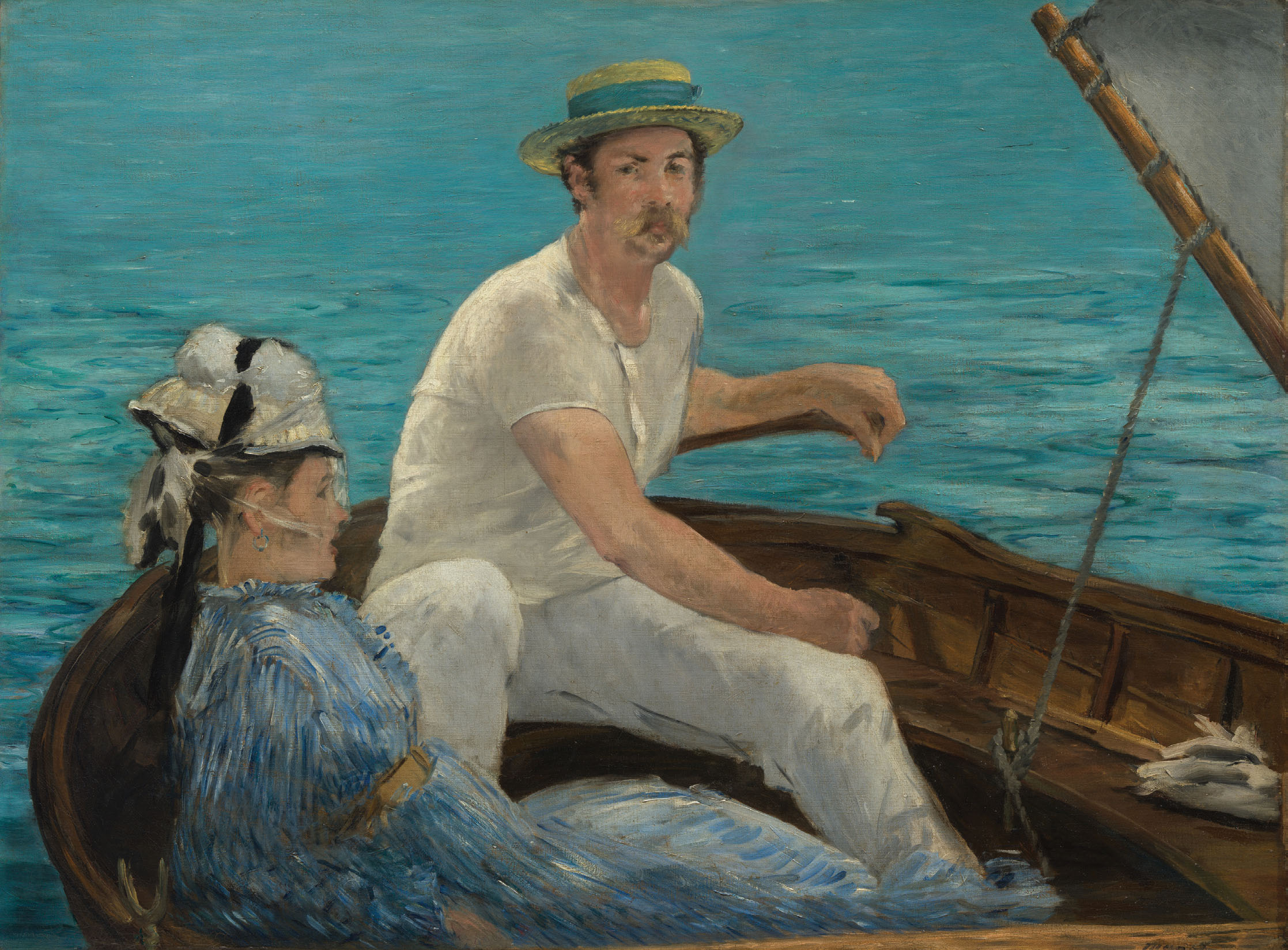
During the summer he and his family spent in Gennevilliers in 1874, Édouard Manet often crossed the Seine to paint with Claude Monet at Argenteuil. Influenced by his friend’s preference for painting en plein air, Manet experimented with a lighter palette, aiming to capture the fleeting effects of natural light on a subject for which they shared an affection — boats.
A reflection of “la vie moderne,” boating had become a fashionable pastime among the middle class. Although he resisted association with the Impressionists, Manet exhibited aspects of their sensibilities in the flickering application of paint in this piece, particularly in the woman’s dress and the eddies of the water created by the passage of the boat. The broad planes of color and strong diagonals reflect the influence of Japanese prints as well.
To emphasize the flat, two-dimensional aspects of the painting, the artist created a low vantage point for the viewer, omitting a horizon line and any visible land beyond the water, and employing an increasingly smooth texture in the brushstrokes as they mount to the top of the blue plane of water. Upon seeing the work displayed at the Salon of 1879, Mary Cassatt deemed it “the last word in painting.”
William Trost Richards (1833–1905)
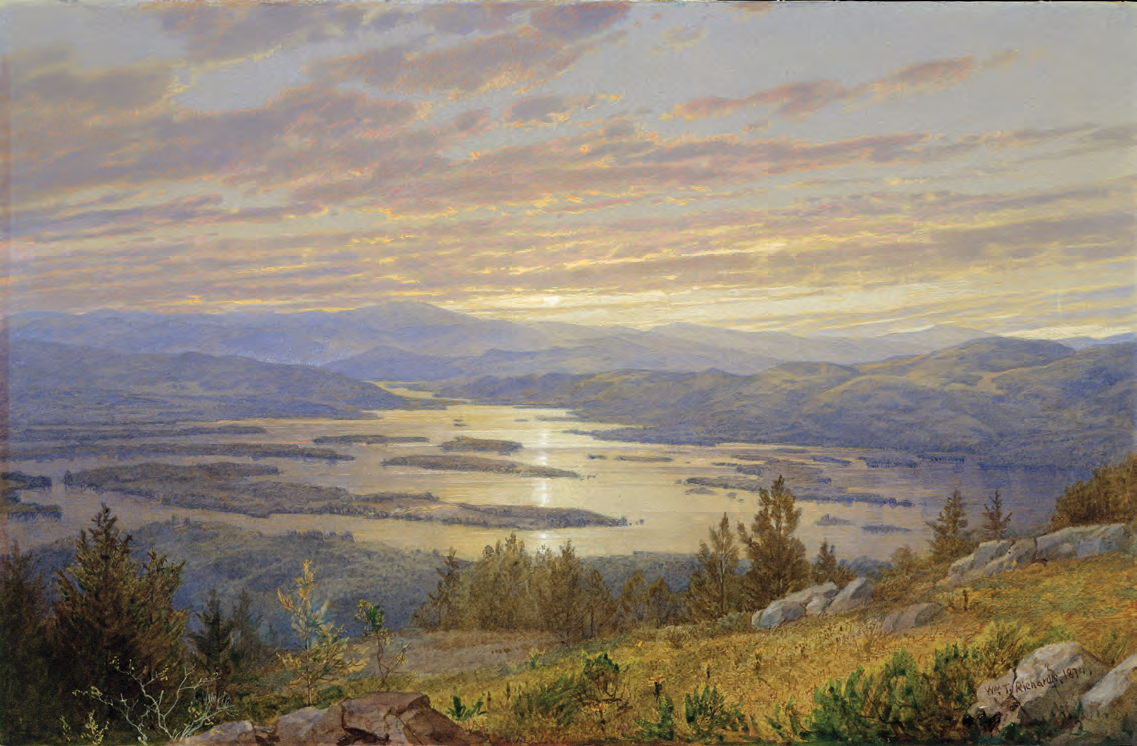
An early contributor to the annual exhibitions of the American Society of Painters in Water Color, William Trost Richards helped raise the profile of the medium significantly in the United States. Here, his radiant sunset depiction of island-studded Lake Squam from Red Hill in New Hampshire hints at his admiration for the stunning sky paintings of New York oil painter Frederic Church.
Although Richards’ small-scale landscapes are the nearest counterpart in watercolor to the paintings of his idol and other contemporaries in the Hudson River School, he broadly rejected the romanticized and stylized approach of the group. In contrast, his paintings combine topographical precision and strong design with a remarkable sense of light and atmospheric breadth to create meticulous factual renderings.
James McNeill Whistler (1834-1903)
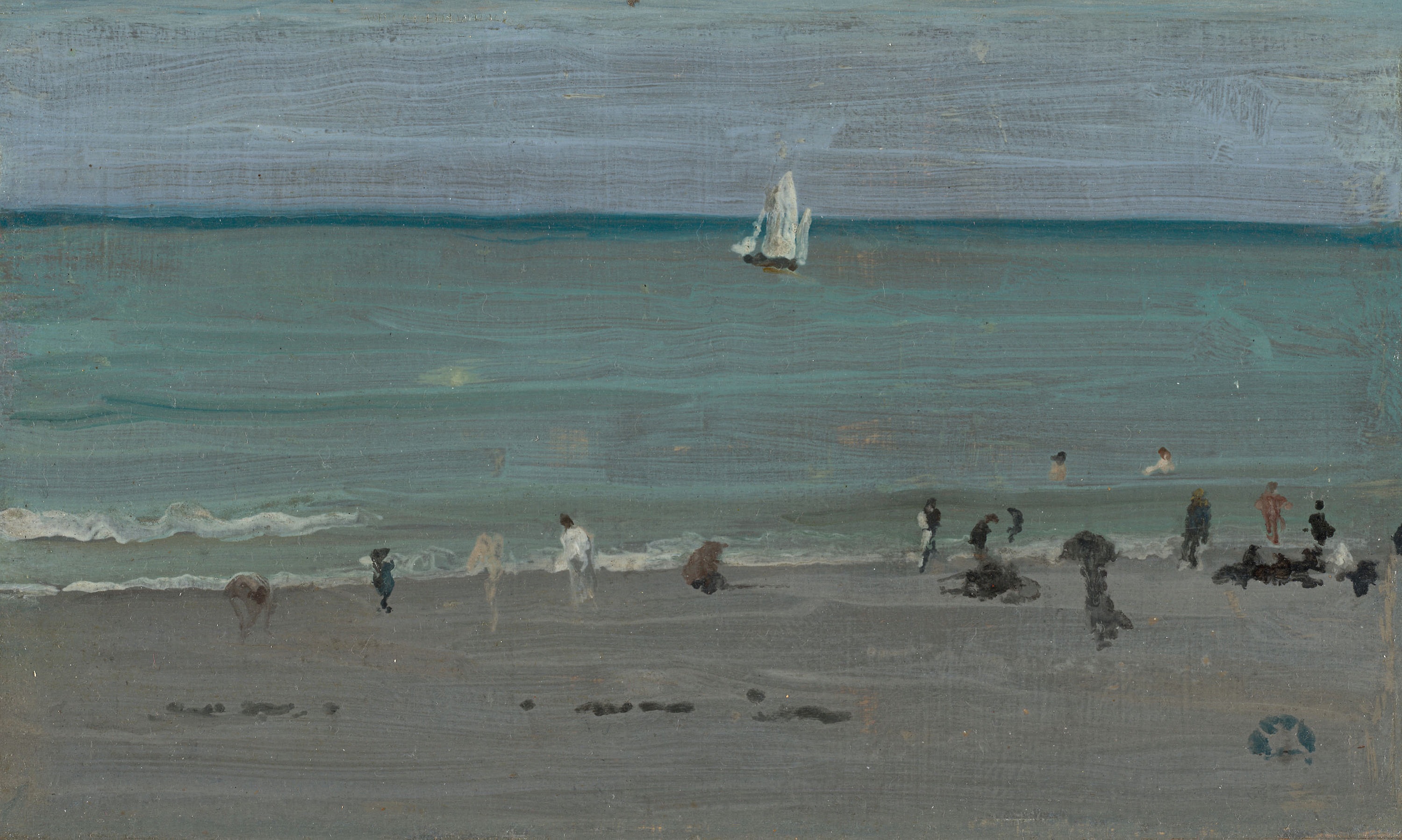
Having spent most of his life in Paris and Lon-don, American-born James McNeill Whistler (1834–1903) drew inspiration from a host of artistic influences, including the Dutch masters, Spanish Baroque, French contemporary Realists, Japanese decorative art, and the Pre-Raphaelites, to develop his unique painting style. Rejecting the popular notion that art should contain moral or historical meaning, he focused instead on creating harmony and effecting mood through the use of color, tone, brush-stroke, texture, and composition.
Painted en plein air, this intimately scaled seascape marked a distinct shift from the artist’s studio-produced nocturnes of the previous decade. Here he used the sparest of compositional elements to evoke the serene coastal atmosphere on the spot. Broad horizontal bands of blues and gray suggest sky, ocean, and sand, with dabs of thin paint giving economical yet expressive form to around a dozen figures on the windswept beach. Though the brushstrokes are predominantly heavy, the painting is imbued with a sense of lightness and delicacy, heightening our perception of this scene as a fleeting moment in time.
Thomas Moran (1837-1926)
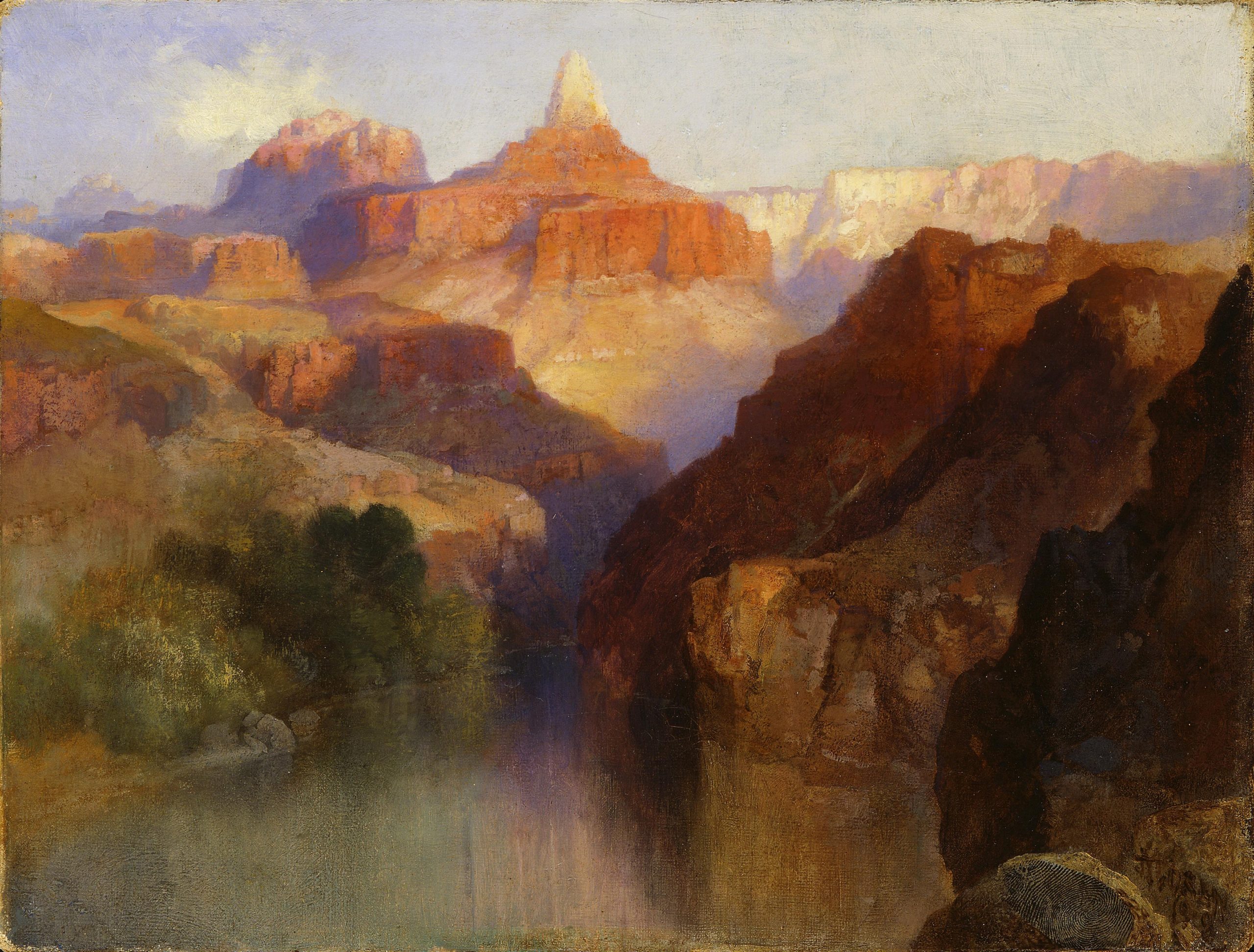
Buffalo Bill Center of the West, purchased by the Board of Trustees in honor of Peter H. Hassrick
An invitation to join the first formal expedition to Yellowstone in 1871 set English-born Thomas Moran (1837–1926) on the unlikely path to becoming one of the best-known names in Western American art. His paintings documenting the geological wonders of the area earned him a spot on John Wesley Powell’s third exploratory trip to the Grand Canyon just two years later.
Traveling by boat down the Colorado River, Moran worked furiously every time Powell’s troop pulled ashore to rest, making sketches of the magnificent scenery that he would later turn into more formal, polished paintings back in his studio. Of the Grand Canyon, the artist said, “It was by far the most awfully grand and impressive scene that I have ever yet seen.”
In this view of Zoroaster Peak, now known as Zoroaster Temple, the Colorado River fills the foreground and reflects the colors of the canyon walls — from deep plum to lavender, ochre, and chalky white. In the lower right corner, beside his signature — TYM for Thomas “Yellowstone” Moran — you may be able to make out his thumbprint, which he added to prove authenticity.
Moran traveled widely, but returned to the Grand Canyon in his later years, producing paintings and etchings well into his 80s; indeed, he was 81 years old when he painted Zoroaster Peak (Grand Canyon, Arizona). At his death in Santa Barbara, California, in August 1926, he was memorialized as the “Dean of American Landscape Painters.”
Claude Monet (French, 1840-1926)
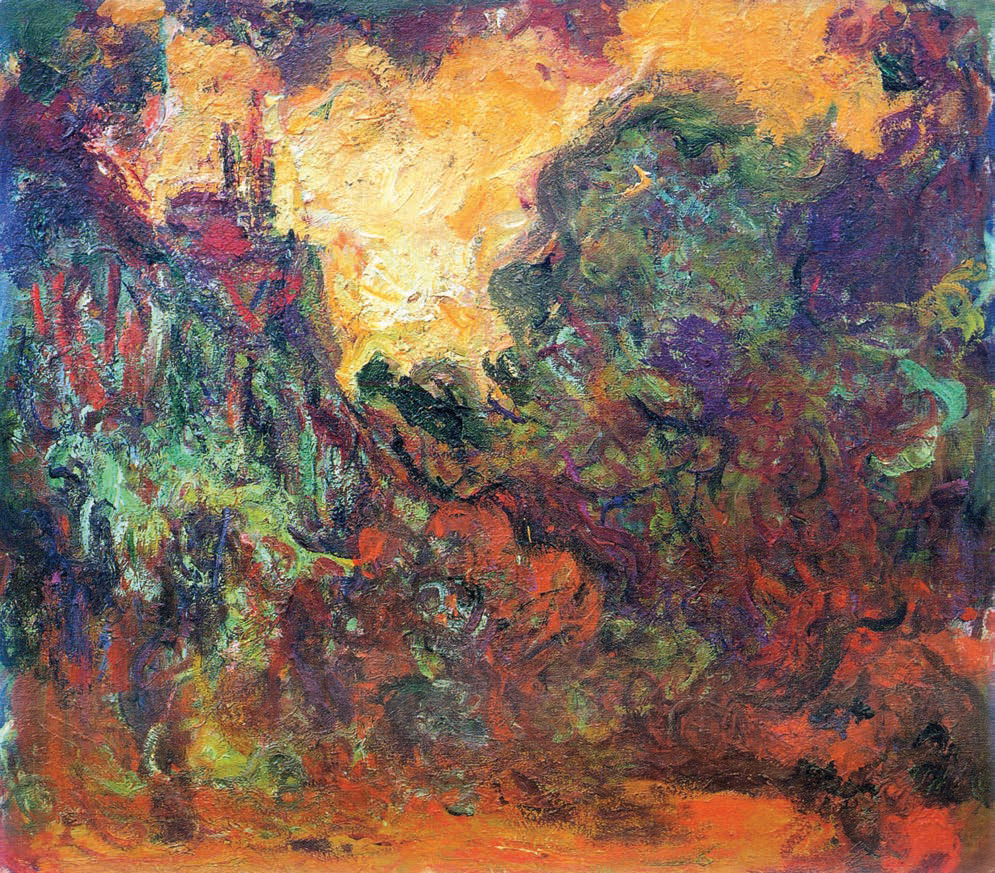
In his later years, Claude Monet (1840–1926) stayed close to home, relying increasingly on his garden at Giverny for inspiration. Due in part to failing eyesight, his work from this period reflects a marked change in the artist’s use of color. His brushstrokes became broader, and his hues darker and muddier, with more browns, yellows, and purples.
First diagnosed with cataracts in 1912, the artist carefully adapted his approach to color by memorizing the placement of paint on his palette. In 1923, with only 10 percent of his vision in his left eye and considered legally blind in his right, Monet finally agreed to undergo surgery. The procedure, along with corrective lenses, restored enough vision in his right eye that he was able to return to work in 1924.
Although struggles with his vision undoubtedly caused self-doubt and frustration, he remained productive throughout his 70s and 80s, transforming his technique by enlarging his canvases, experimenting with compositional cropping, and playing with tonal harmonies. A balance of representation and abstraction, Monet’s late body of work redefined the master of Impressionism as a forebear of modernism.
Monet’s Anathema
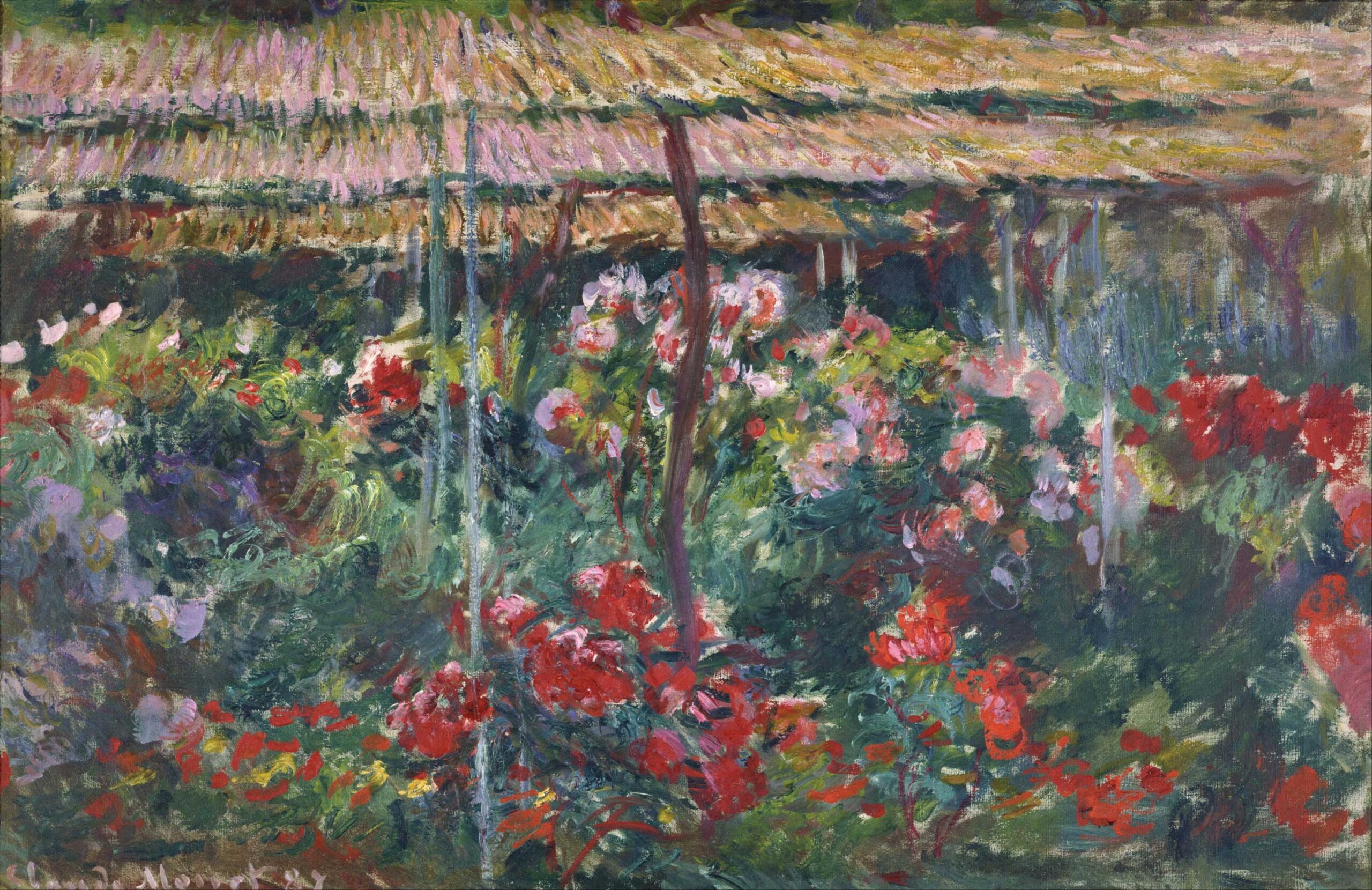
Claude Monet began work on his flower garden immediately upon moving to Giverny in May 1883. Starting on the area nearest to his rented home, the artist planted some of his favorite annuals — poppies, sunflowers, and nasturtiums.
As he continued to convert the former farming plot to a flowering garden, he would often trade seeds and cuttings with his friend and fellow Impressionist painter Gustave Caillebotte.
When he was finally able to purchase the house and land several years later, he took a much more ambitious approach to the garden, hiring full-time gardeners and building a large greenhouse to begin introducing a more extravagant range of species — irises, peonies, delphiniums, Oriental poppies, and asters.
Carefully curated through the eyes of the artist, the packed garden offered up a steady stream of inspiration. Just as some flowers began to wither, others would begin to bud.
“Bare earth was anathema to him,” wrote Claire Joyes, author of Claude Monet at Giverny — A Tour and History of the House and Garden. “He avoided dark flowers; conversely, he could never get enough of blue … he abhorred single flowers, permitting double blooms only in roses and herbaceous peonies; and he loathed variegated foliage.”
Pierre-Auguste Renoir (1841–1919)
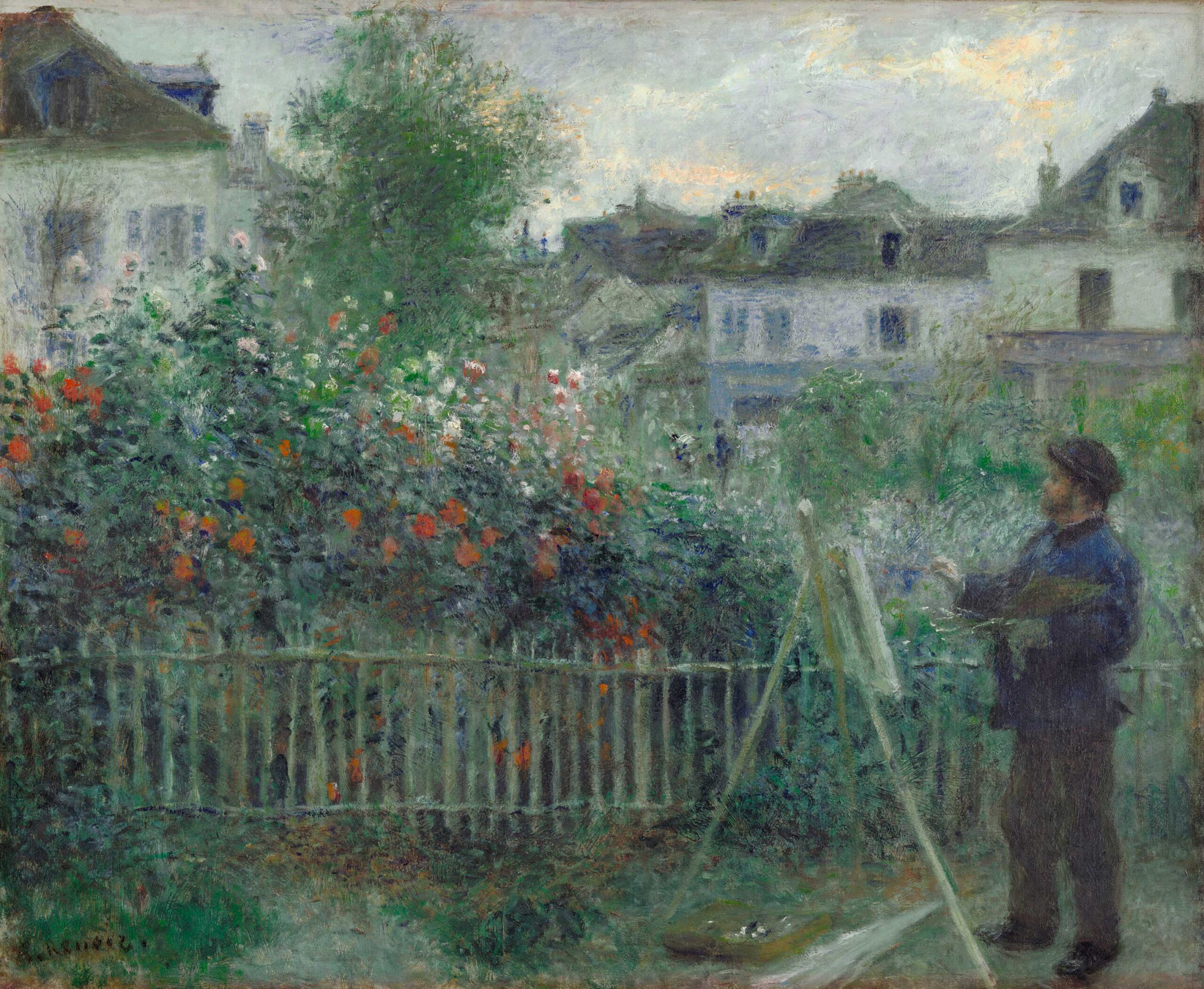
While staying with Claude Monet at his home in the village of Argenteuil on the outskirts of Paris, Pierre-Auguste Renoir (1841–1919) captured his friend in pursuit of their shared passion — painting outdoors.
The day was overcast and the dahlias were in full bloom as the artists set up in a neighbor’s yard, just a few steps from Monet’s own house — the cream-colored one with blue shutters on the left. While Monet focused intently on the flowers, Renoir found inspiration in his fellow painter.
Here we see the carefully posed artist standing before his canvas, a brush in his right hand and in his left, his palette and other brushes. A box of paints and an umbrella lay beneath the easel.
An X-ray would later reveal that this piece had been painted over a portrait of Monet’s wife, Camille, but it remains unclear whether Monet or Renoir created the earlier work.
Helen Henderson Chain (1849–1892)
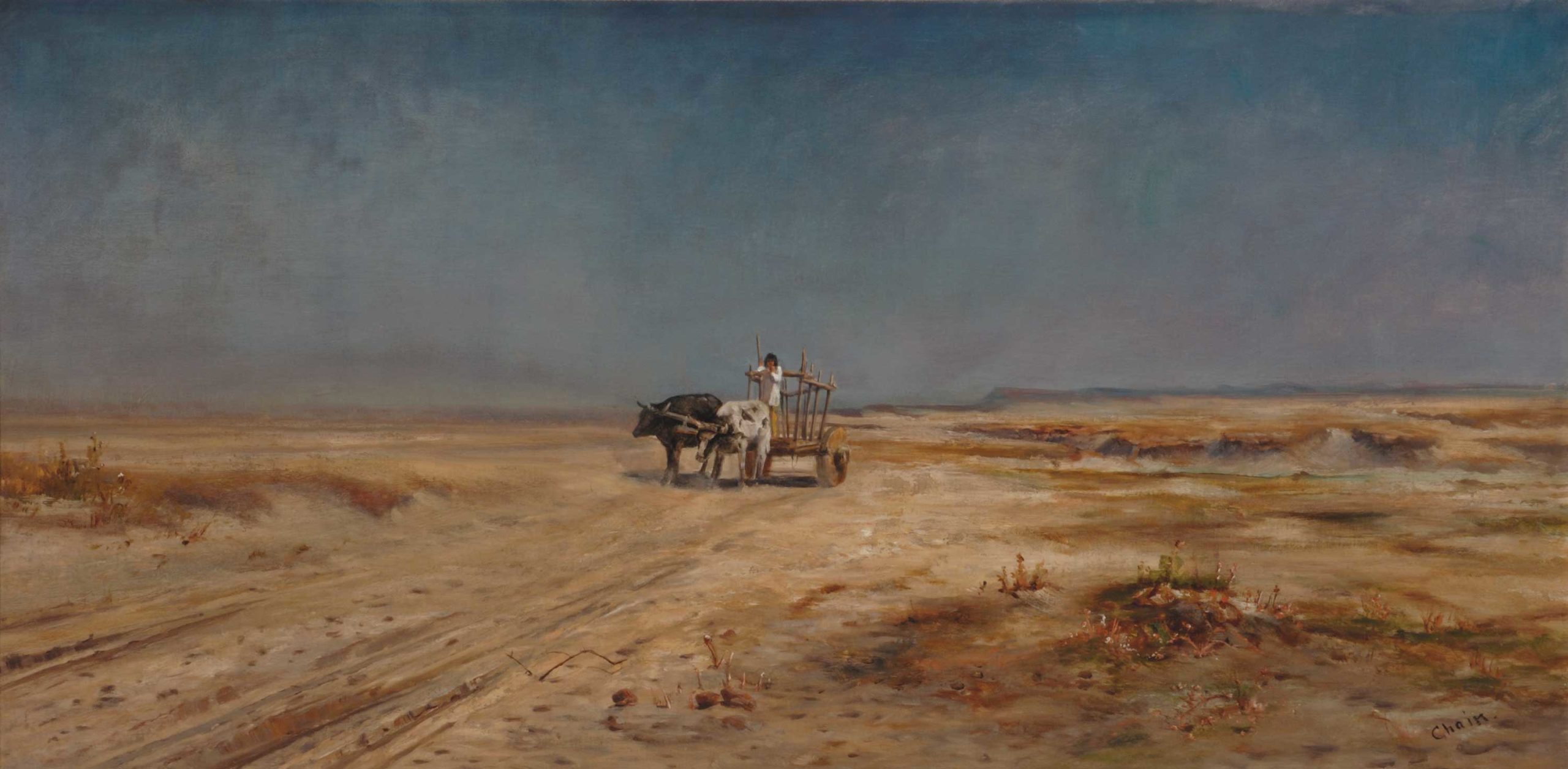
Colorado’s first female resident artist, Helen Henderson Chain, was born in Indianapolis and studied with Hudson River School painter George Innes before moving to Denver with her husband, James. There, they helped establish the Chain & Hardy Bookstore, which would eventually become the city’s first art gallery and publishing house.
Converting a back room of the store to a studio, she taught art classes and sold supplies. Rather than paint the ladylike florals and still life paintings expected from women artists of her day, she preferred to tackle the rugged Colorado landscape en plein air.
Dressed in corsets and long skirts, she scrambled up the area’s most notable peaks, art supplies in tow, becoming the first non-native woman to summit the 14,000-foot Mount of the Holy Cross.
A true pioneer, she also headed south to paint the pueblos of New Mexico decades before the Taos School painters would discover them.
In 1882, she became the first woman to exhibit paintings at the National Academy of Design in New York, showing two of her New Mexico pueblo scenes.
Tragically, Chain and her husband died 10 years later when their ship wrecked in a typhoon while traveling in Asia.
William Merritt Chase (1849–1916)
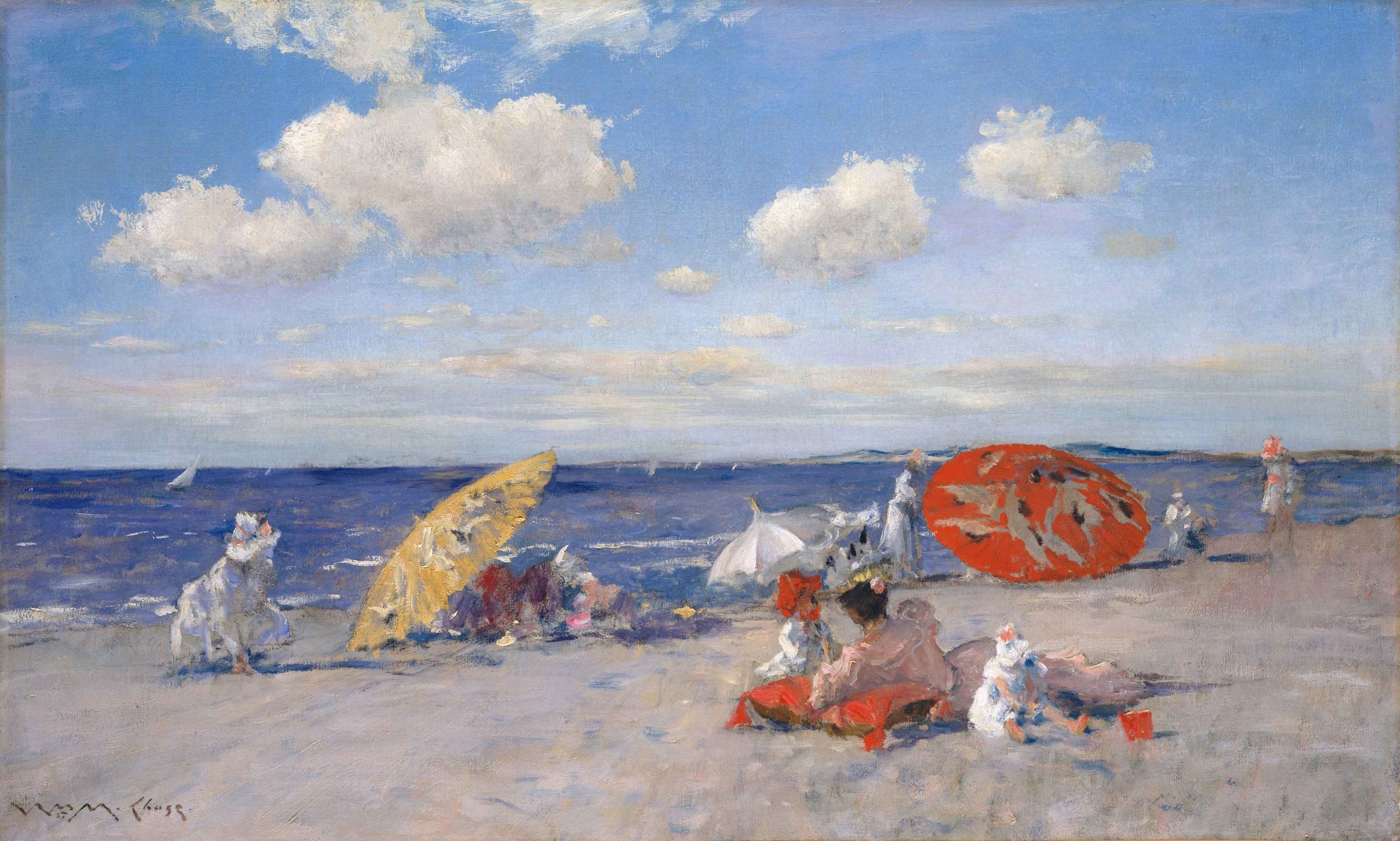
William Merritt Chase was already a popular artist in Manhattan in 1891, when prominent art patron Janet Hoyt invited him to Shinnecock, Long Island, to start an open-air school of art.
At the time, plein air painting was still relatively new to the United States, but growing rapidly in popularity. Each summer for the next 12 years, a hundred or so students flocked to the beach resort for Chase’s outdoor classes. Two days a week, he instilled in them the virtues of dispensing with sketches or preparatory drawings and painting directly on canvas in the presence of nature.
The decade-plus that Chase spent with the school would mark a new chapter in his art and family life. While the artist was busy teaching or painting, his wife and children — who were featured often in his plein air work of the area — enjoyed the wild countryside and beaches near their summer home. Chase likewise thrived on the change of pace and scenery.
As can be seen above, the artist’s output from Shinnecock consists primarily of loose and luminous, high-key landscapes, and is considered to be among the finest examples of American Impressionism.
Abbott Handerson Thayer (1849–1921)
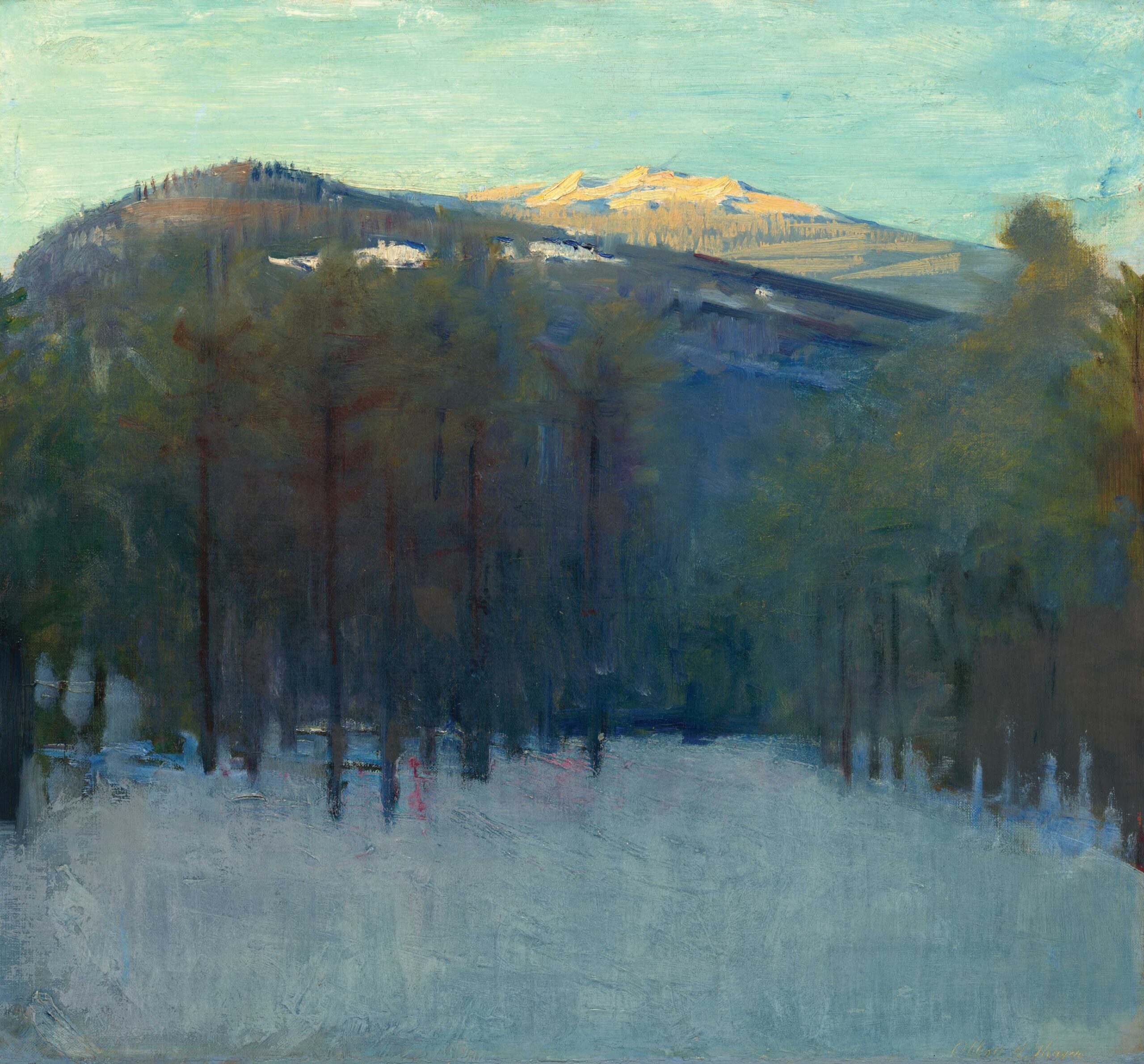
Better known for his idealistic and allegorical paintings of women as angels and Madonnas, Abbott Handerson Thayer (American, 1849–1921) regarded his landscapes as a form of portraiture. Aiming to stay true to nature, he painted these scenes en plein air, most often finding inspiration in views of Mount Monadnock, which overlooked his studio.
Upon learning that a group of developers wanted to purchase an expanse of “this dear mountain,” Thayer successfully organized the local community around its conservation. To support their work, he founded the Thayer Fund, which, through the National Audubon Society, paid for wardens to protect bird sanctuaries up and down the East Coast.
In this depiction, Thayer cast the majority of the scene in shadow, save for the stark white mountain peak illuminated by the rising sun in the dawn sky. He represented the mountaintop in thick, expressive strokes of paint, further differentiating the peak from the smoothly rendered landscape in the foreground.
So important was the mountain to the artist that upon his death his ashes were scattered on its summit.
Leon Wyczółkowski (Polish, 1852–1936)
![Leon Wyczółkowski, "U WRÓT CHAŁUBIŃSKIEGO [AT THE CHAŁUBIŃSKI GATE]," c. 1905, pastel on paper, 30 1/2 x 42 1/3 in., National Museum in Kraków](https://www.outdoorpainter.com/wp-content/uploads/2025/12/Leon_Wyczolkowski_-_U_Wrot_Chalubinskiego_-_MNK_III-r.jpg)
A major figure of the Young Poland movement, Wyczółkowski studied in Munich and Kraków before traveling to Paris, where he absorbed the light-focused sensibilities of the Barbizon School and Impressionism. Back at home, he helped to define a national artistic identity by founding the Society of Polish Artists “Sztuka.” Initially celebrated for his plein air paintings of fishermen and laborers, Wyczółkowski turned to the Polish landscape, especially the rugged Tatras, in the early 20th century.
In this view (above), delicate pastel strokes lend the cloud forms a vaporous, dreamlike presence, while bold earth tones ground the image. “It’s like stepping into the heart of nature itself,” says one modern curator. “Those clouds are the very breath of the mountains.”
Exemplifying the artist’s ability to balance realism with emotional resonance, the painting stands as a testament to plein air’s power to convey both place and presence. Wyczółkowski captured not just what the eye sees, but what the soul senses in the wild.
John Henry Twachtman (1853–1902)
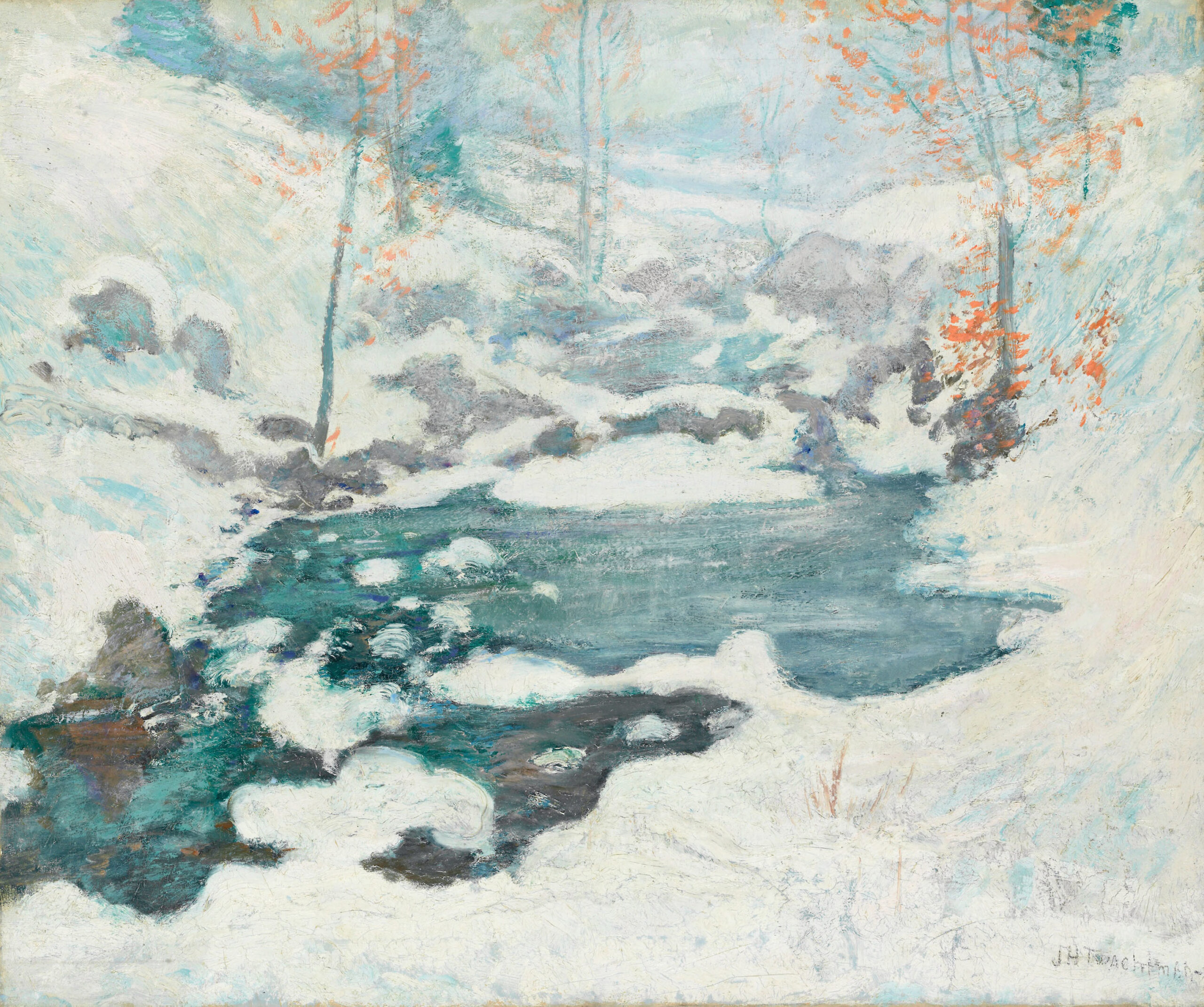
During the last decade of his life, John Henry Twachtman (1853–1902) frequently painted views of the brook, falls, and pools surrounding his home in Greenwich, Connecticut. The work ranges from naturalistic representations to enlarged, simplified visions in which the sky is often eliminated.
The oriental feel of these pieces points to the artist’s study of Zen philosophy and Japanese art. And while their analytic nature has much in common with Monet’s garden scenes, they more closely resemble Whistler’s nocturnes, conveying a tonal, spiritual response to the landscape. A contemporary critic observed, “Twachtman painted day, as Whistler painted night.”
Displaying this poetic sensibility, the artist often explored the quiet beauty of a snowy landscape, finding the icy terrain conducive to contemplation and regeneration. Keying his palette to the saturated white of snow, ice, and atmosphere, he gradually built up dense layers of paint in “Icebound” to mimic the accumulation of snow on frozen ground.
The sinuous curves that define the snow and ice against the water suggest movement in an otherwise tranquil environment. Almost square in format, the painting’s harmonious composition exemplifies Twachtman’s opinion that “never is nature more lovely than when it is snowing.”
Albert Edelfelt (Finnish, 1854–1905)
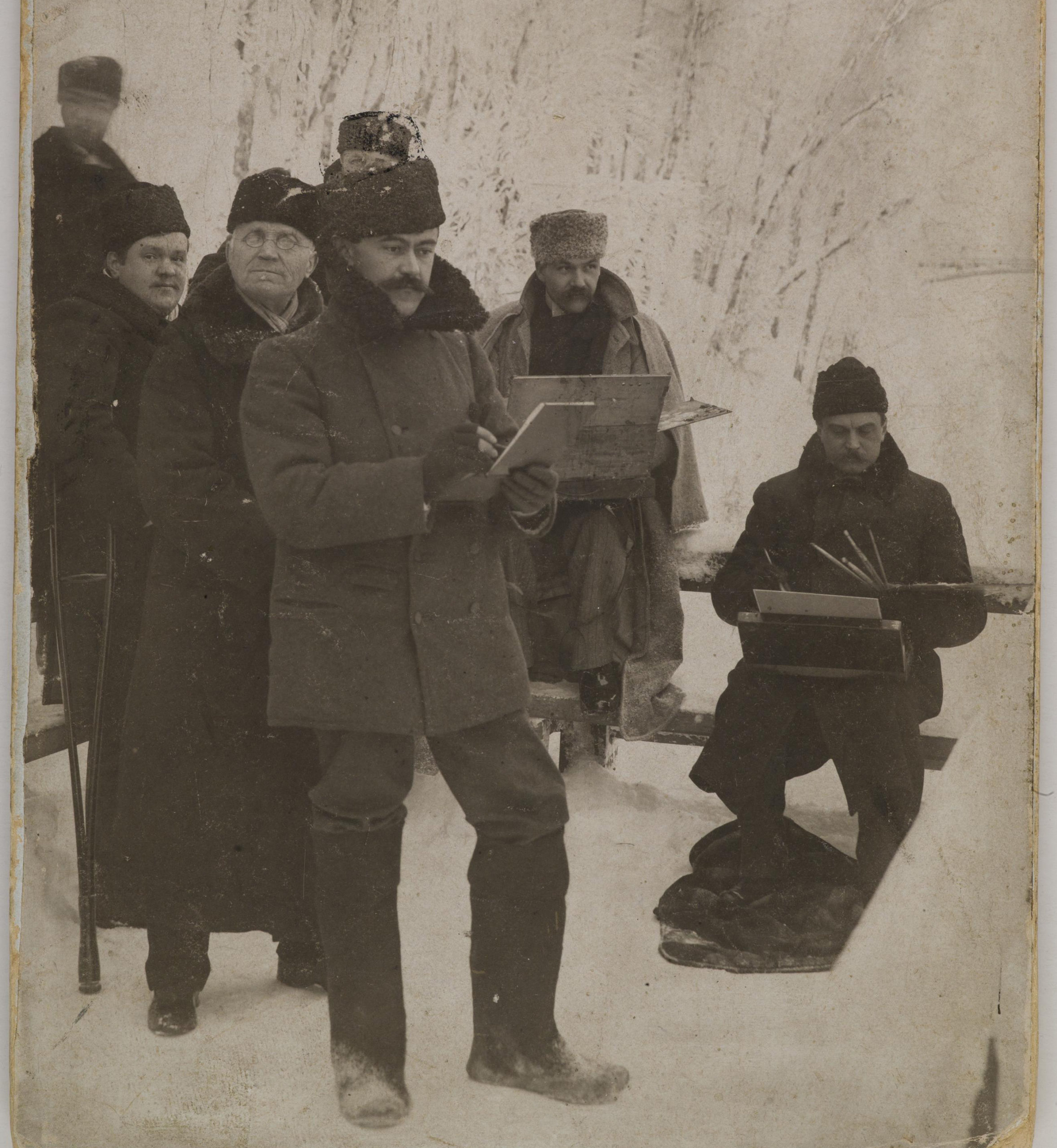
Best known for his portraits of royalty and high society patrons, Albert Edelfelt developed a lifelong love of plein air painting in Paris, where he studied under Jean-Léon Gérôme at the Ecole Nationale des Beaux Arts.
Although he spent 15 years in the City of Lights, it wasn’t until he returned to Finland that he found inspiration for the bulk of his plein air work — having completed only one large outdoor painting in all his time in France.
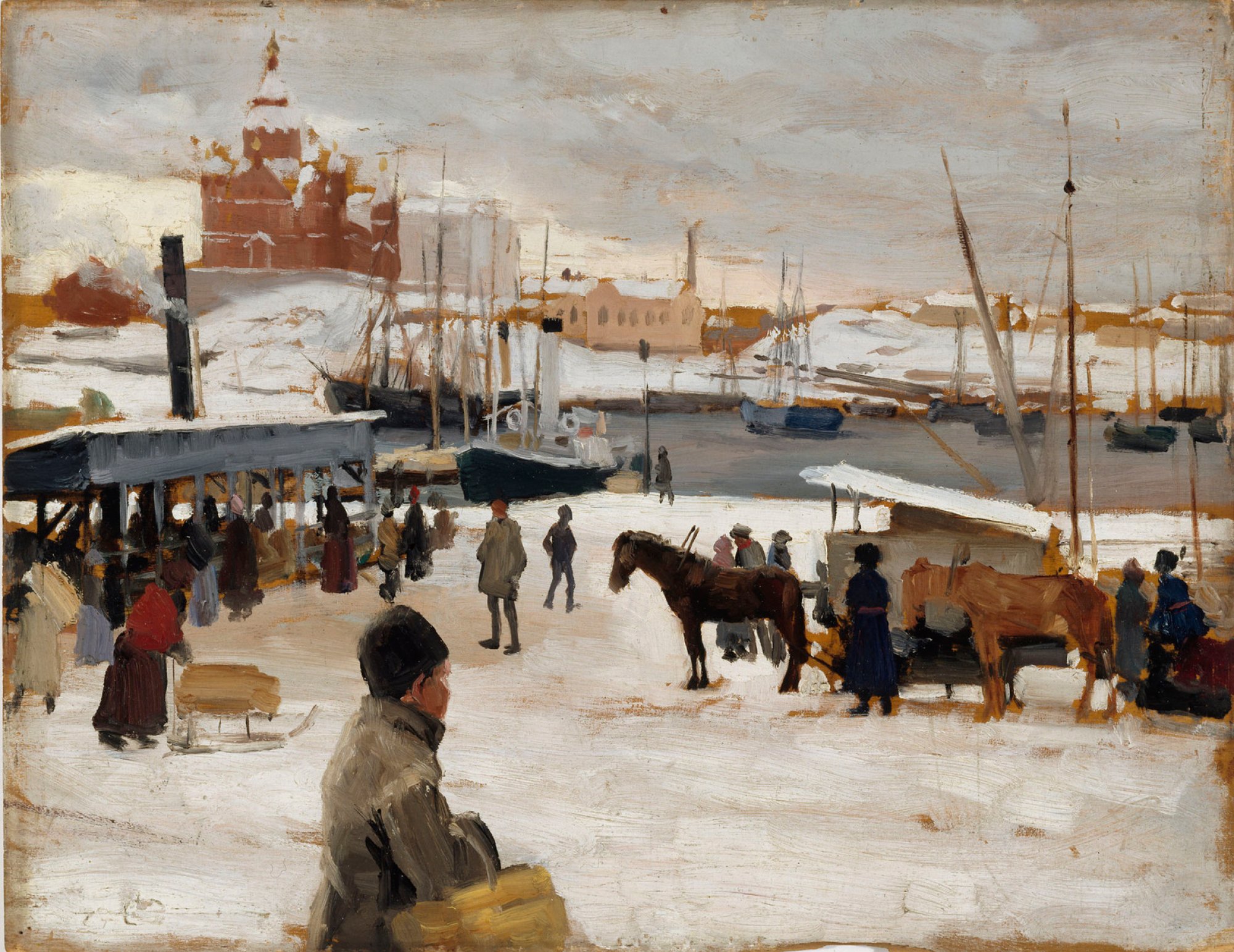
In 1879, the artist’s mother rented a summer villa in Haikko, near Porvoo, where he was born. Visiting her there, Erdelfelt fell in love with the archipelago and its residents, finding them an inexhaustible source of subject matter. In all, he spent 26 summers there, in between winter visits to Paris and St. Petersburg, and he painted some 220 works in and around the area.
Initially a strict realist, Edelfelt continued to work in Paris when he could, and as a result his landscapes and some of his less formal portraits became progressively looser, almost impressionistic. It’s unknown how far he might have pushed that approach, as he died suddenly of a heart attack in his beloved Haikko, at 51 years old.
John Singer Sargent (1856–1925)
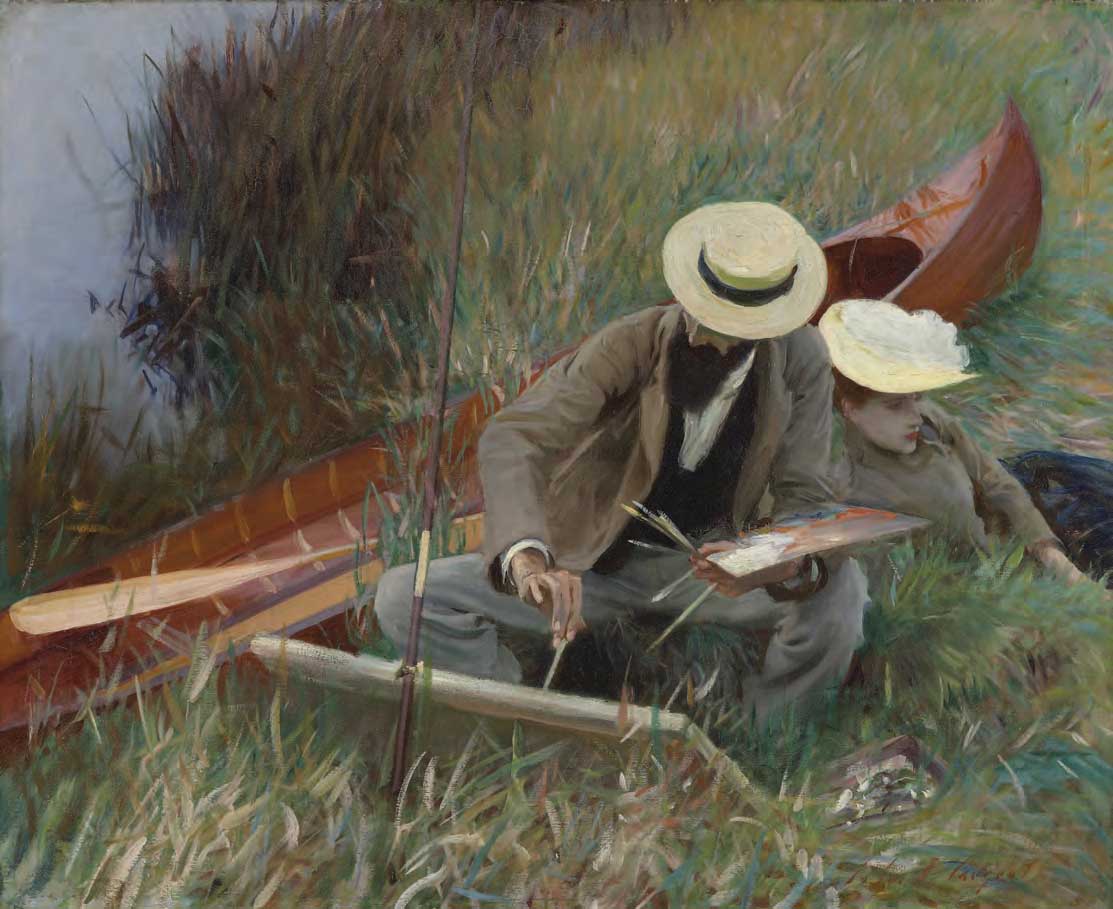
Inspired in part by the Impressionist works of his friend Claude Monet, the American expatriate John Singer Sargent experimented with portrait compositions whose informality and naturalness stood in sharp contrast to his commissioned studio portraits of elegant society types. In this piece, Sargent’s subjects were French painter Paul Helleu and his wife, Alice, who visited the artist at Fladbury, in England’s Cotswolds, where he was spending the summer of 1889.
Liberated from strict pictorial conventions, Sargent featured the compositional asymmetry, natural light, and casual inattention of his “sitters” in this plein air painting about the act of plein air painting. See how Sargent carefully records the precise pose of Paul’s hand and his intense concentration as he applies paint to his canvas. Nearby, Alice appears listless as she gazes away from her husband, surrounded by reeds and grasses indicated with energetic, brushy strokes. The composition is deliberately constructed around the diagonals of the red canoe and the easel.
Stanhope Forbes (1857–1947)
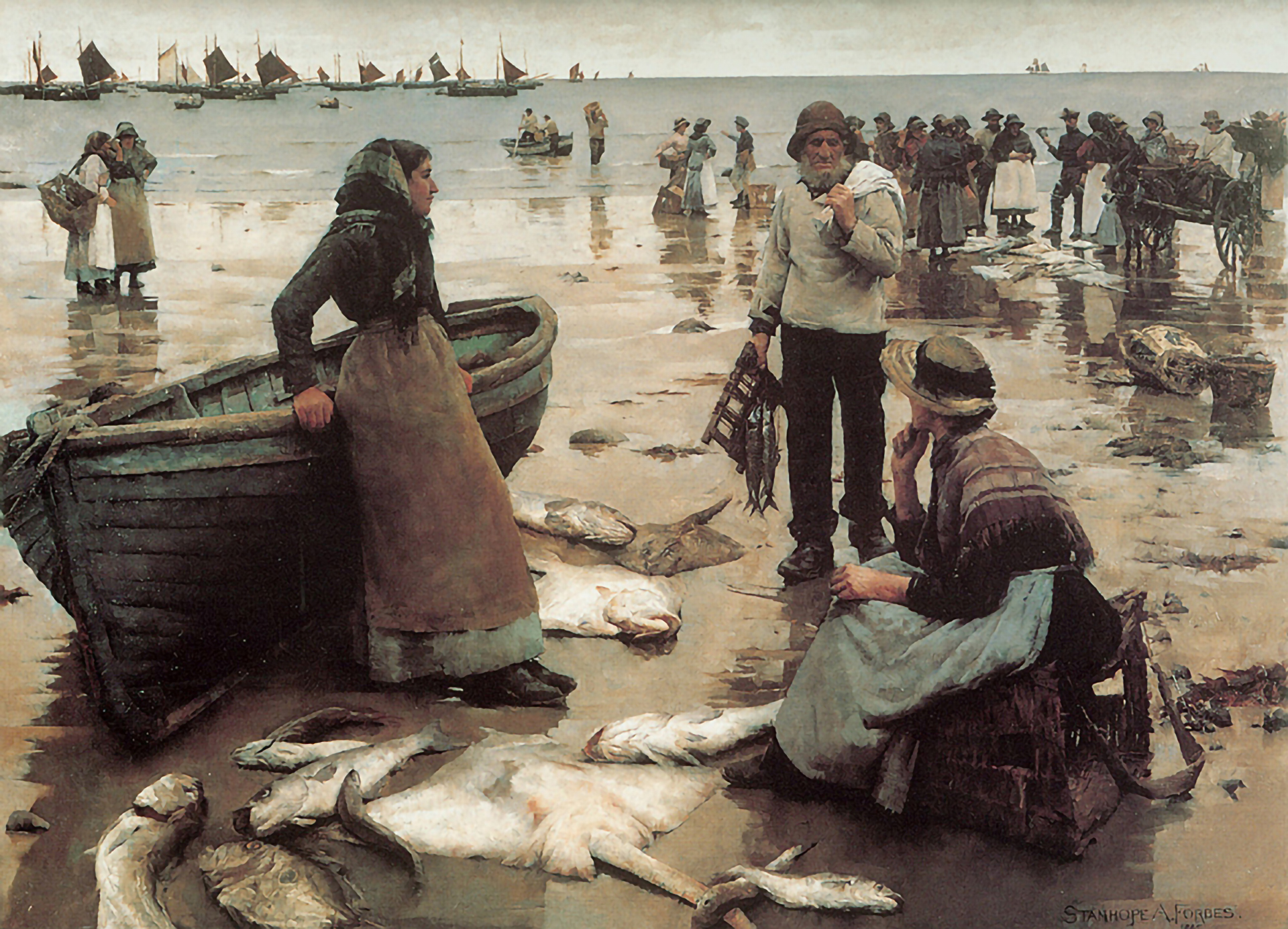
Inspired by French plein air painter Jules Bastien-Lepages (1848–1884) to paint outdoors and use ordinary people as models, Stanhope Forbes abandoned plans to make a living as a portrait painter. Believing an artist must “stick to one branch of painting and make it [their] own,” he said, “I must do plein air or nothing. It’s the only way to achieve success.”
Attracted by the quality of light and the mild climate, Forbes moved to Newlyn, a small fishing village in Cornwall, England, where he could paint outside most of the year. The shimmering reflections and rich textures of the harbor, along with the traditionally attired fishermen and women, provided endless opportunities for the bold brushwork and tonal painting that were the hallmark of his work.
“Anything more beautiful than this beach at low water I never saw, and if I can only paint figures against such a background as this shining mirror-like shore makes, the result should be effective,” he wrote.
Shortly after arriving in Cornwall, Forbes began sketches for a 5 1/2 x 9-foot painting of a fish auction on the beach near Newlyn. The artist’s process included “painting entirely and absolutely out of doors, braving all difficulties and relying in no way upon sketches or studies, with which later on the work could be comfortably finished within the walls of a studio.”
Such a monumental canvas proved too unwieldy, however, and he abandoned it in favor of a more manageable — but still impressive — 4 x 5-foot piece. He worked on the painting for just under a year, finishing in the spring of 1885.
Carl Rungius (1869–1959)
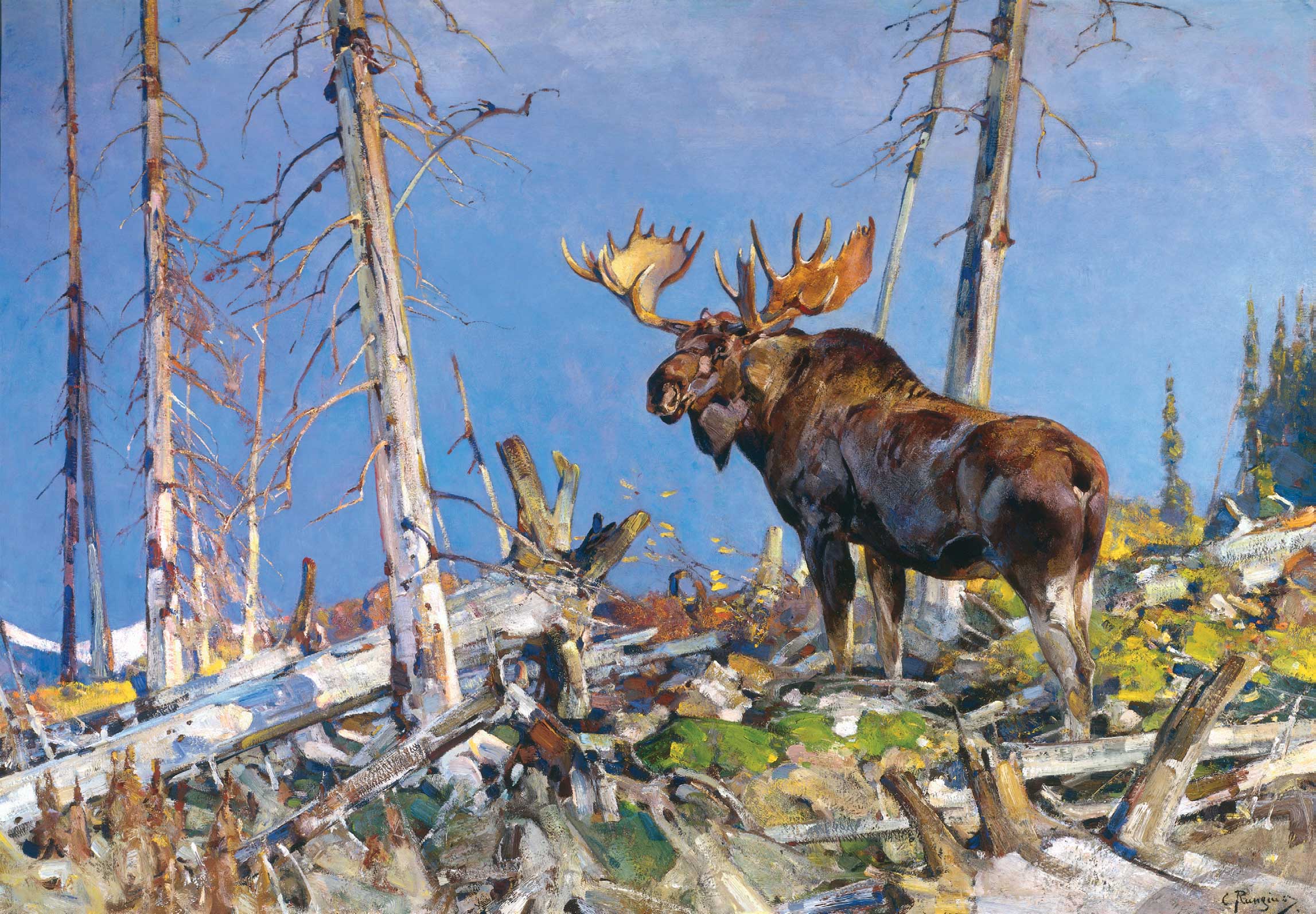
Primarily known as a painter of big game, Carl Rungius earned himself a revered position in the canon of plein air painting for his fidelity to working directly from life. He once said, “If you paint outdoor scenes in the studio, your color gets too hot. Only if you paint outdoors do you see the cool, silvery tones that are the true colors of nature.”
Rungius developed his skills for depicting animals with anatomical accuracy at the zoo in Berlin, his birthplace. In 1894, he traveled to Cora, Wyoming, to hunt and sketch, and never went home. For the next decade, he spent his summers in Wyoming, painting and hunting moose, pronghorn, and bighorn sheep in the Rocky Mountains, then retreated to his studio in New York, where he dedicated the long, cold winters to painting large-scale oils from his plein air studies.
In 1905, the plein air artist embarked on a career-defining expedition to the Yukon Territory. Describing the hordes of mosquitoes that plagued his party, he said, “When I got through with an oil sketch, the palette looked like a mince pie with the crust off! And I had to clean the sketch itself with a forceps to remove the carcasses.”
W. Herbert Dunton (1878-1936)

Following our focus on artists whose paintings centered on conservation and preservation, we feature the early Taos, New Mexico, painter and printmaker W. Herbert Dunton. He was passionate about preserving the vanishing spirit of the Old West in his oil paintings, murals, and lithographs.
Dunton grew up working as a ranch hand and cowboy, studied at the Art Students League of New York, created illustrations for major magazines, and ultimately struggled with financial and health setbacks during the Great Depression.
Dunton is shown in this hand-tinted photograph working in New Mexico on a plein air painting of a cowboy on horseback.
John Steuart Curry (1897–1946)
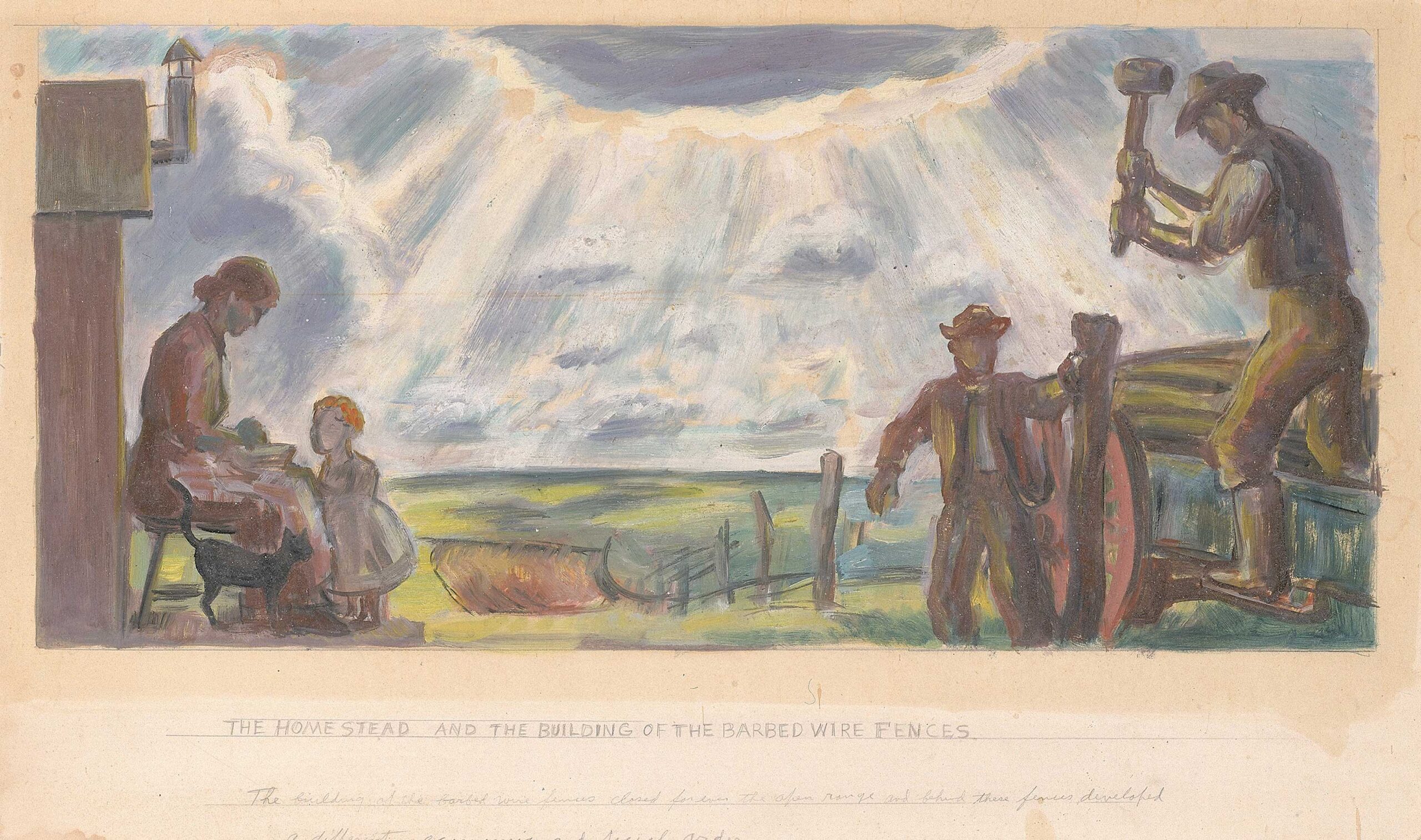
Born on a farm near Dunavant, Kansas, John Steuart Curry (1897–1946) believed that art should appeal to the common people. Rejecting both European academicism and modernism, he focused his work on familiar scenes of the American Midwest.
In this study for the second of two oil-and-tempera murals originally installed at the Department of the Interior building in Washington D.C., Curry capitalized on his standard palette — reds for Oklahoma’s dust and soil, gold for sunlight, and green for far-off fields of grain.
Of the scene, he said, “Building the barbed wire fences closed forever the open range, and behind these fences developed a different economic and social order.”
Storytelling landscapes like this one solidified Curry’s place alongside fellow masters Thomas Hart Benton (1889–1975) and Grant Wood (1891–1942) in the annals of American regionalist painting.
Rex Brandt (1914-2000)
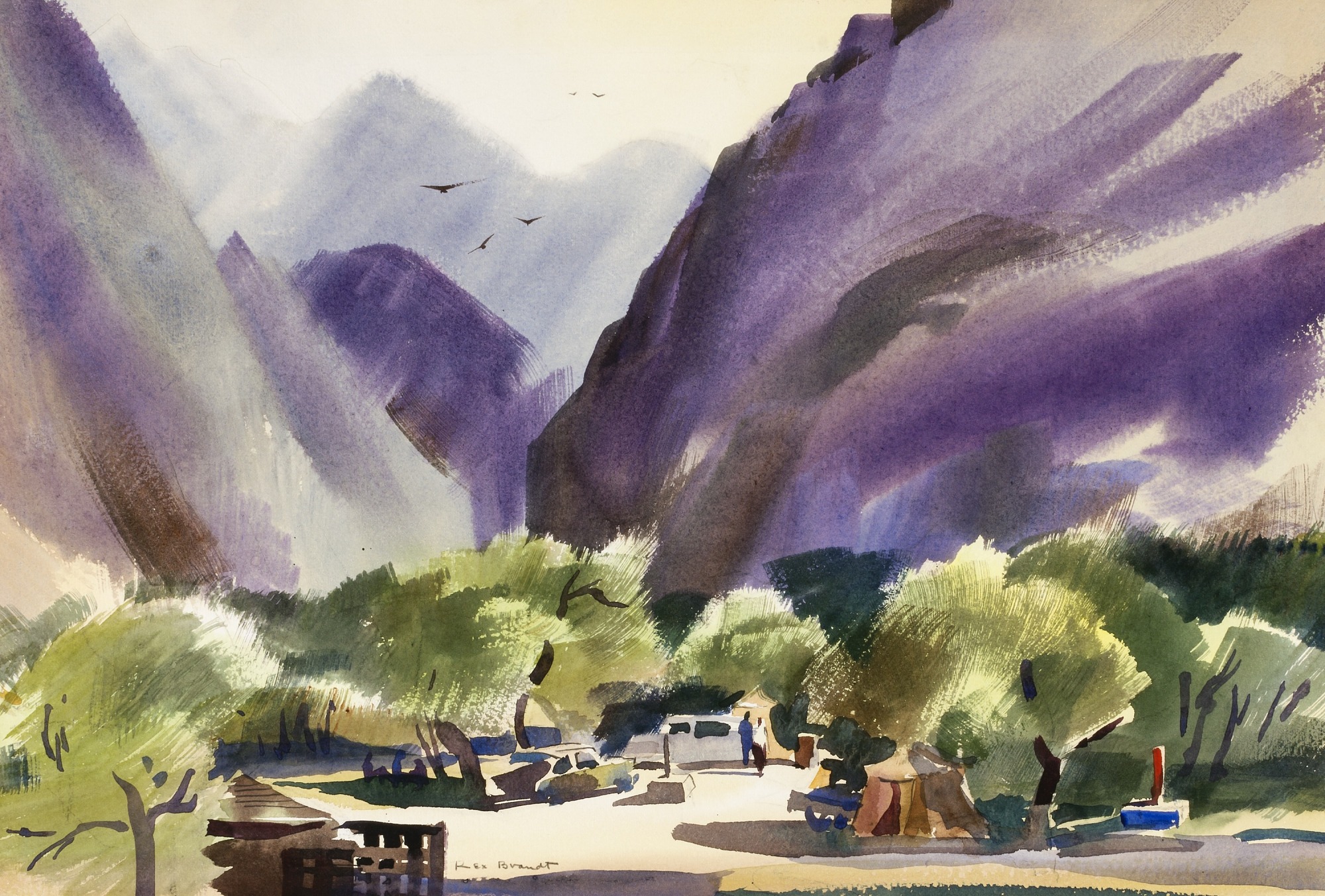
Considered one of the most important California Scene Painters (a group of American regionalists who flourished from the 1920s to 1960s), Rex Brandt (1914-2000) created joyful plein air paintings that perfectly conveyed the feel of mid-century Southern California.
Though he dabbled in gouache and oil, as well as printmaking and etching, he preferred watercolor for its portability and the speed at which he could work. Drawing from a variety of influences, he incorporated the bold colors of Latino murals and the spontaneity of Japanese landscapes in his watercolors.
Of painting outdoors, Brandt said, “Have you ever noticed, you sit down alongside a stable, and the first thing you get is this awful smell. You’re painting this barn, but what you smell will change the colors you use in the barn. And then maybe the next thing you do is hear a horse whinnying, and it beguiles you. And that changes what you feel about the scene. Sight, sound, smell — all the senses — will do those things. It’s natural but it means keeping your perceptive pores open.”
After World War II, he and Phil Dike formed the Brandt-Dike Summer School of Painting in Corona Del Mar. From 1947 to 1952, he also taught watercolor painting and composition courses at Chouinard Art Institute. Through these classes and his 11 instructional books, Brandt educated and inspired a generation of professional watercolor artists.
The editorial above is part of a series that spotlights the work of historic plein air artists whose work has been featured in PleinAir magazine.
Published bi-monthly, PleinAir magazine is focused on landscape paintings by historical and contemporary artists, art collections, events, and the process of creating plein air paintings. Beautifully designed with rich reproductions on high-quality paper, PleinAir features the top artists and artworks from around the world. Start your subscription here.
Story prepared for the web by Cherie Dawn Haas, Editor of Plein Air Today